- AI content optimization uses AI to improve existing or new content for search performance and AI-search visibility.
- The workflow: audit on-page SEO, optimize titles and meta, build keyword clusters, fix readability, add internal links.
- The 2026 difference is also optimizing for citation by AI engines through structure, schema and crawler access.
- Most tools do classic optimization or AI-crawler access; doing both in one process is the advantage.
- Write in content capsules: question as the heading, direct answer first, then your own experience and a real source. A companion YouTube video reinforces the same page.
AI content optimization is the practice of using AI tools to improve content so it performs better in search, covering on-page SEO (titles, meta, structure, keywords, readability) and increasingly AI search visibility (getting cited by ChatGPT, Perplexity and Google AI Overviews). It is how you take a page from written to ranking and citable.
This guide is part of our AI content writing series. We will define AI-powered content optimization, walk through it step by step, cover the tools, and unify the two halves most guides keep separate: optimizing content quality and making that content citable by AI search engines.
What is AI content optimization?
AI content optimization is using AI to analyze and improve content so it ranks higher and gets found more often. In practice it means using AI to audit on-page SEO, refine title tags and meta descriptions, cluster keywords and match search intent, improve readability and structure, and surface internal linking opportunities. The newer layer is optimizing content so AI search engines can read, trust and cite it.
AI optimization vs traditional content optimization
Traditional content optimization is largely manual: a person audits a page against ranking factors and rewrites it. AI content optimization speeds this up: AI finds content gaps, suggests metadata, scores readability and proposes clusters in minutes instead of hours. The other difference is scope. Classic optimization targets Google rankings only. AI content optimization in 2026 also targets AI search surfaces like AI Overviews, where structure and citability decide whether you appear.
How to optimize content with AI (step by step)
Step 1: Audit on-page SEO and find gaps
Start with an audit. Use an AI optimization tool to compare your page against what currently ranks and surface content gaps: subtopics, questions and entities the top results cover that you do not. Closing those gaps improves topical authority and is often the fastest ranking win.
Step 2: Optimize title tags and meta descriptions
Your title tag and meta description drive click-through rate from the search results. Use AI to draft several variations that lead with the keyword and a clear benefit, then pick the most compelling. A/B headline testing helps if you have the traffic. Strong metadata lifts CTR even when your ranking stays the same.
Step 3: Build keyword clusters and match intent
Use AI to group related keywords into clusters and map each cluster to the right page and search intent. This prevents keyword cannibalization (two pages fighting for the same term) and ensures each page fully covers one topic. For the full approach, see our keyword research guide.
Step 4: Improve readability and structure
AI is good at tightening prose. Use it to shorten sentences, simplify jargon, and reorganize content under a clean heading hierarchy (H2/H3) with lists and tables. Readable, well-structured content keeps readers on the page and is far easier for both Google and AI engines to parse and extract.
Step 5: Find internal linking opportunities
Internal links spread authority and help crawlers understand your site. Ask an AI tool to suggest relevant internal links between your pages using descriptive anchor text, prioritizing links from high-authority pages to ones you want to rank. This pairs naturally with SEO content writing, where the content is created in the first place.
AI content optimization tools
The AI content optimization tools landscape includes content scoring platforms (Surfer SEO, Clearscope, Frase, Outranking), broad SEO suites (Semrush, Ahrefs), and conversion-focused platforms (Optimizely). Each helps with some mix of auditing, scoring, briefs and on-page suggestions. The best AI content optimization platform for you depends on whether you need scoring, clustering, or full audits.
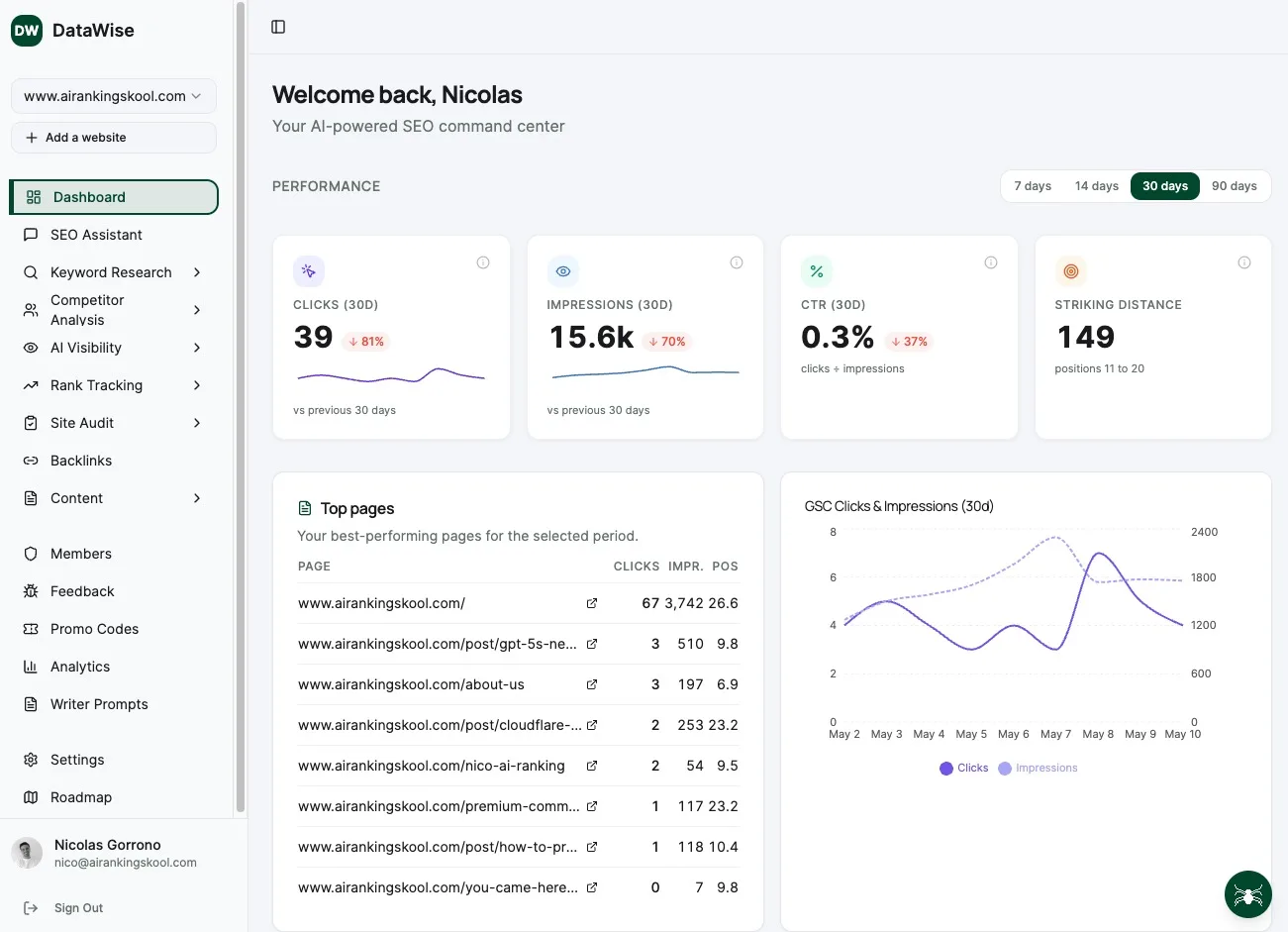
Inside AI Ranking we use DataWise, free for members. Beyond classic optimization, it scores whether a page is structured to be cited by AI search engines (the part the mainstream tools skip) and flags crawler-access issues. That fusion of quality optimization and AI citability is the point of this guide.
Do not pick a tool by how much of the writing it does for you. The opposite is true: the best AI tool for optimization is the one that makes it easiest to inject your own experience, data and point of view. A tool that drafts the whole thing leaves you with regurgitated AI slop that reads like everyone else's. A tool you steer with your context produces the one thing competitors cannot copy. Optimization is editing your knowledge in, not handing the topic over.
Optimizing content for AI search
Optimizing for AI search means making your content easy for AI engines to read, trust and quote in their answers. This is the differentiator, and it has three parts: structure, crawler access and freshness. The umbrella term is generative engine optimization, covered fully in our GEO guide and our broader AI SEO guide.
Structured, citable content (schema and semantic markup)
Lead every section with a direct, quotable answer, then support it with clean H2/H3 headings, lists, comparison tables and TL;DR summaries. Add structured data using schema.org / JSON-LD (Article, FAQPage, HowTo) and clean semantic markup so engines understand what each part of the page means. Self-contained, single-page answers get cited more than scattered ones.
AI crawler access: robots.txt, llms.txt, sitemap.xml
AI engines can only cite what they can crawl. Make sure your robots.txt does not block AI crawlers you want, keep your sitemap.xml current, and consider adding an llms.txt file that points models to your key pages. The honest caveat on llms.txt: it is a useful, low-cost convention, but there is limited evidence major AI crawlers fetch it yet, so do not rely on it alone.
Which AI crawlers to allow
| Crawler | Who runs it | Allow to appear in |
|---|---|---|
| GPTBot | OpenAI | ChatGPT training and answers |
| ChatGPT-User | OpenAI | ChatGPT live browsing answers |
| PerplexityBot | Perplexity | Perplexity answers |
| ClaudeBot | Anthropic | Claude answers |
| Google-Extended | Gemini and AI features |
Content freshness and single-page answers
AI engines favor current, self-contained content. Update key pages as facts change, timestamp them, and make sure each important question is fully answered on one page rather than split across several. Freshness plus a clean, single-page answer is a strong citability signal.
The content capsule technique (how to actually get cited)
The single biggest on-page lever for getting cited is writing in content capsules. A content capsule is a self-contained block that takes one real question, uses it as the heading, and answers it directly in the first sentence or two, before any build-up, so an AI engine can lift the whole answer in one piece. AI search quotes self-contained answers, so you write each section to be quotable on its own.
The pattern is simple: question as the H2 or H3, a direct answer immediately underneath, then the supporting detail, and a table where it helps. For "What does yerba mate do for your body?" the capsule opens with the actual answer ("Yerba mate acts on multiple body systems at once through its polyphenols, caffeine and saponins...") instead of warming up with background. That one habit measurably increases your chances of showing up as a source in AI answers.
Start from the questions AI is trying to answer
Capsules work best when each page answers a real cluster of questions. Pull the People Also Ask questions around your topic (DataWise does this with a location and a search depth, which matter more than people expect), export them, then have an LLM cluster the similar ones so each page covers one group without overlapping the next. Now every page is a complete capsule answering a tight set of related questions. The full question-mining method is in our keyword research guide.
The four things that make a capsule citable
- Answer first. Lead the section with the direct answer to its question. This is the capsule itself, and it is what AI engines lift.
- Inject your own experience. Add the first-hand detail only you have: a result you got, a mistake you made, a measured outcome. This is what separates your page from regurgitated AI slop, and it is the one thing AI cannot fabricate.
- Back every claim with a real source. Link claims to high-quality sources on the contextual keyword. This matters most for Your Money or Your Life topics (health, finance, legal), where unsupported claims will not get trusted or cited.
- Internally link on the contextual keyword. Link relevant phrases to the right pages on your site so readers and crawlers can move through your content and authority flows where you want it.
Reinforce the page with a video
Content optimization for AI search is not only on-page text. YouTube is one of the most-cited sources in AI answers (and it is Google-owned), so a short companion video on the same topic gives the engines another asset to pull from and reinforces that you are the authority on it. Make a simple video covering the same questions your page answers, then embed it on the page. It is one of the highest-leverage optimization moves most people skip.
The old KPI for a blog post was traffic. That still matters, but a well-sourced, experience-rich post now does a second job: it teaches the AI models that you are the subject-matter expert on this topic. Every capsule you publish, answered properly and backed with real sources, compounds your authority in the models, not just in Google.
Common AI content optimization mistakes
- Over-relying on AI (the 30% rule). A common heuristic: let AI do no more than about 30% of the final work, with human editing, examples and judgement leading the rest. Unedited AI text reads thin and rarely ranks.
- Optimizing for keywords, not intent. Stuffing terms while ignoring what the searcher actually wants kills both rankings and citations.
- Ignoring AI-search structure. Optimizing only for Google and forgetting direct answers, schema and crawler access leaves AI citations on the table.
- Set-and-forget. Content decays. Pages need periodic refreshes to stay ranked and cited.
- Letting hallucinations slip through. AI invents facts and citations. Verify everything before publishing.
How we teach AI content optimization
AI Ranking, founded by Nico Gorrono, teaches business owners and marketers a single playbook that covers both classic optimization and AI-search citability, instead of leaving you to stitch tools together. You get the workflow, prompt templates, DataWise, and feedback on your own pages.
If you want content that ranks in Google and gets cited by AI search, join the community and start optimizing with a system.
Learn AI Content Writing hands-on inside the community
Courses, live calls and DataWise to optimize every draft against the live SERP before you publish.