- SEO content writing is creating content optimized to rank in search by matching keywords, search intent and on-page structure.
- The process: keyword research, analyze intent, structure the page, write for readers, add E-E-A-T and internal links.
- In 2026 the bar is higher: content must also be structured to get cited by ChatGPT, Perplexity and Google AI Overviews.
- AI tools speed up SEO content writing, but human editing and real expertise are what make it rank.
- Our main system is a custom GPT 'project' you build once from three files (your tone of voice, your site's link map, your real experience) so every draft sounds like you, cites your wins and links internally.
SEO content writing is the practice of creating written content (blog posts, guides, landing pages and product pages) that is optimized to rank in search engines by targeting the right keywords, matching search intent and following on-page SEO best practices. The goal is content that ranks, earns organic traffic, and answers the reader's question better than competing pages.
This guide is part of our AI content writing series, and it is written for beginners. We will cover what SEO content writing is, how to do it step by step, the best practices that still matter in 2026, a worked example, the tools worth using, and the part most guides ignore: how to write SEO content that AI search engines like ChatGPT and Google AI Overviews actually cite.
What is SEO content writing?
SEO content writing is writing content designed to rank in search engines and satisfy the people who find it. In practice that means choosing a target keyword, understanding the search intent behind it, structuring the page with clear titles, headers and meta tags, and writing genuinely useful copy that answers the query. It sits at the intersection of two jobs: helping the reader and signaling relevance to search engines like Google.
SEO content writer vs SEO copywriter
An SEO content writer and an SEO copywriter overlap, but their goals differ. An SEO content writer focuses on informational content (guides, blog posts, how-tos) built to rank for search queries and build topical authority. An SEO copywriter focuses on persuasion: sales pages, ads and product copy meant to convert. Both use SEO, but the content writer optimizes for organic discovery and the copywriter optimizes for action. Many writers do both.
Why SEO content writing matters in 2026
SEO content writing matters because organic search is still where most buying journeys start, and well-ranked content compounds: a single evergreen page can drive traffic for years. In 2026 there is a second reason. AI answer engines pull their responses from web content, so the pages that are well-structured and authoritative now feed both Google rankings and AI citations. Writing for search is no longer optional if you want to be found.
How to write SEO content (step by step)
Here is how to do SEO content writing as a repeatable process, even as a beginner.
Step 1: Keyword research and topic selection
Start by finding what people actually search. Use a keyword tool (Google Keyword Planner, Ahrefs, Semrush, or our own DataWise) to find a primary keyword with real search volume and a difficulty (KD) you can realistically compete for. Mix in long-tail keywords: longer, more specific phrases that are easier to rank for and often closer to a buying decision. Build content around topics, not single keywords. For the full method see our keyword research guide.
Step 2: Analyze search intent
Before writing, look at what already ranks for your keyword. The current top results tell you the search intent: informational (a guide), commercial (a comparison), transactional (a product page) or navigational. Match it. If the page-one results are all step-by-step guides, a sales page will not rank no matter how optimized it is. Matching intent is the single biggest predictor of whether your content ranks.
Step 3: Structure the page (title, meta, headers, URL)
Good on-page SEO makes your content easy for search engines to understand. Cover the basics: a compelling title tag with the keyword near the front, a meta description that earns the click, a single clear H1, and a logical hierarchy of H2 and H3 headings. Keep the URL slug short and keyword-relevant. Add alt text to images and structured data (schema) where it fits. This structure also makes content easier for AI engines to extract.
Step 4: Write for readers, place keywords naturally
Write the page for a human first. Use your primary keyword in the title, the first paragraph, at least one header and naturally throughout, plus related terms and synonyms. Do not force it: keyword stuffing (cramming the same phrase in unnaturally) hurts both readability and rankings. There is no magic keyword density target. Cover the topic thoroughly, answer the sub-questions a reader would have, and aim to add information gain (something the existing results do not already say).
Step 5: Add E-E-A-T signals and internal links
Google rewards Experience, Expertise, Authoritativeness and Trust (E-E-A-T), especially for important topics. Show it: include first-hand experience, original examples or data, a credible named author, and cite reputable sources. Then add internal links to related pages on your site using descriptive anchor text. Internal linking spreads authority and helps both readers and crawlers navigate. Optimizing all of this further is the job of AI content optimization.
SEO content writing best practices and tips
- Answer the main question in the first one or two sentences (good for readers, snippets and AI citation).
- Write skimmable content: short paragraphs, descriptive subheads, bullet lists and tables.
- Target one primary keyword per page to avoid competing against yourself (keyword cannibalization).
- Build topical authority by covering a subject in depth across a cluster of linked pages.
- Keep content fresh: update evergreen posts as facts and rankings change.
- Earn the featured snippet by formatting concise, direct answers to specific questions.
- Never stuff keywords or publish thin content just to target a phrase.
5 rules for writing content AI search engines reward
Beyond the basics above, these are the five things we see consistently get content cited by AI search engines like ChatGPT, Perplexity and Google AI Overviews. They are simple, but most pages skip them.
- Turn your headings into questions. Use the real questions people ask as your H2s and H3s, not for every heading, but for a good portion of them. Instead of a section titled "Pricing," write "How much does local SEO cost in 2026?" That small change matches how people actually search and how AI engines read intent.
- Back every claim with a real source. This is the most important rule. Do not write "studies show AI search is growing fast" and leave it there: that is the equivalent of saying "trust me." Whenever you make a claim, link the contextual keyword to a high-quality source that proves it. Cited claims are far more likely to be quoted back by AI.
- Add your own experience. First-hand experience is the one thing AI cannot fabricate, and it is what makes your page different from every competitor saying the same thing. You do not need ten years in a niche: "I tried this and got this result" is enough. Weave in a real example, a screenshot or a measured outcome.
- Use one or two tables. AI search engines love structured data, and a table breaks up a wall of text. A simple comparison or before-and-after table makes your content easier to extract and quote.
- Link internally to the right places. A blog post with no internal links is like a room with no doors: nobody can get in or out. Link to related pages on your site with descriptive anchor text so readers and crawlers can move through your content.
3 content myths that waste your time
These are the mistakes we see most often from people trying to improve their content. None of them work, and two of them actively hurt you.
- Myth: rewriting it again makes it better. Rewriting for the sake of rewriting does not work. If your new version says the same thing in different words, there is no reason for Google or an AI engine to spend crawl budget ranking it. Add experience, sources and structure instead.
- Myth: longer content ranks better. Length is not the goal, precision is. A "how to make toast" post can be 500 words, while a genuinely complex topic needs more. Cover the topic completely, then stop. Do not pad to hit an arbitrary word count.
- Myth: a more complex prompt gives a better draft. Stuffing in 50 instructions and 20 personas ("act as an SEO expert with 25 years of experience who wrote for Microsoft") does not improve the output. What improves it is context: the real questions, the audience, your sources and your experience.
Get the exact prompt and feedback on your drafts
- The Cite Me prompt that runs the web-search, source and experience workflow for you.
- DataWise to pull People Also Ask questions and check whether your draft is citable.
- Direct feedback on your real posts in the twice-weekly live Q&A.
SEO content writing example (before and after)
Here is a simple worked example for the keyword "how to clean a cast iron skillet."
| Element | Before (weak) | After (SEO-optimized) |
|---|---|---|
| Title tag | Cleaning Tips | How to Clean a Cast Iron Skillet (Without Ruining It) |
| Opening line | Cast iron is a popular material with a long history. | To clean a cast iron skillet, scrub it with hot water and a stiff brush while still warm, then dry and re-oil it. |
| Structure | One long block of text | H2 steps, a quick-answer list, a 'mistakes to avoid' table |
| Intent match | History of cast iron (wrong intent) | Step-by-step how-to (matches the query) |
The after version answers the query in the first sentence, matches the how-to intent, and is structured so Google and AI engines can lift the answer. That is the whole game in miniature.
Tools for SEO content writing
The right SEO content writing tools speed up research and catch issues before you publish. Common categories: keyword and SERP research (Google Search Console, Google Keyword Planner, Ahrefs, Semrush), content optimization and scoring (Surfer SEO, Clearscope, Frase, plus Semrush's SEO Writing Assistant), and editing (Grammarly, Hemingway). You do not need all of them.
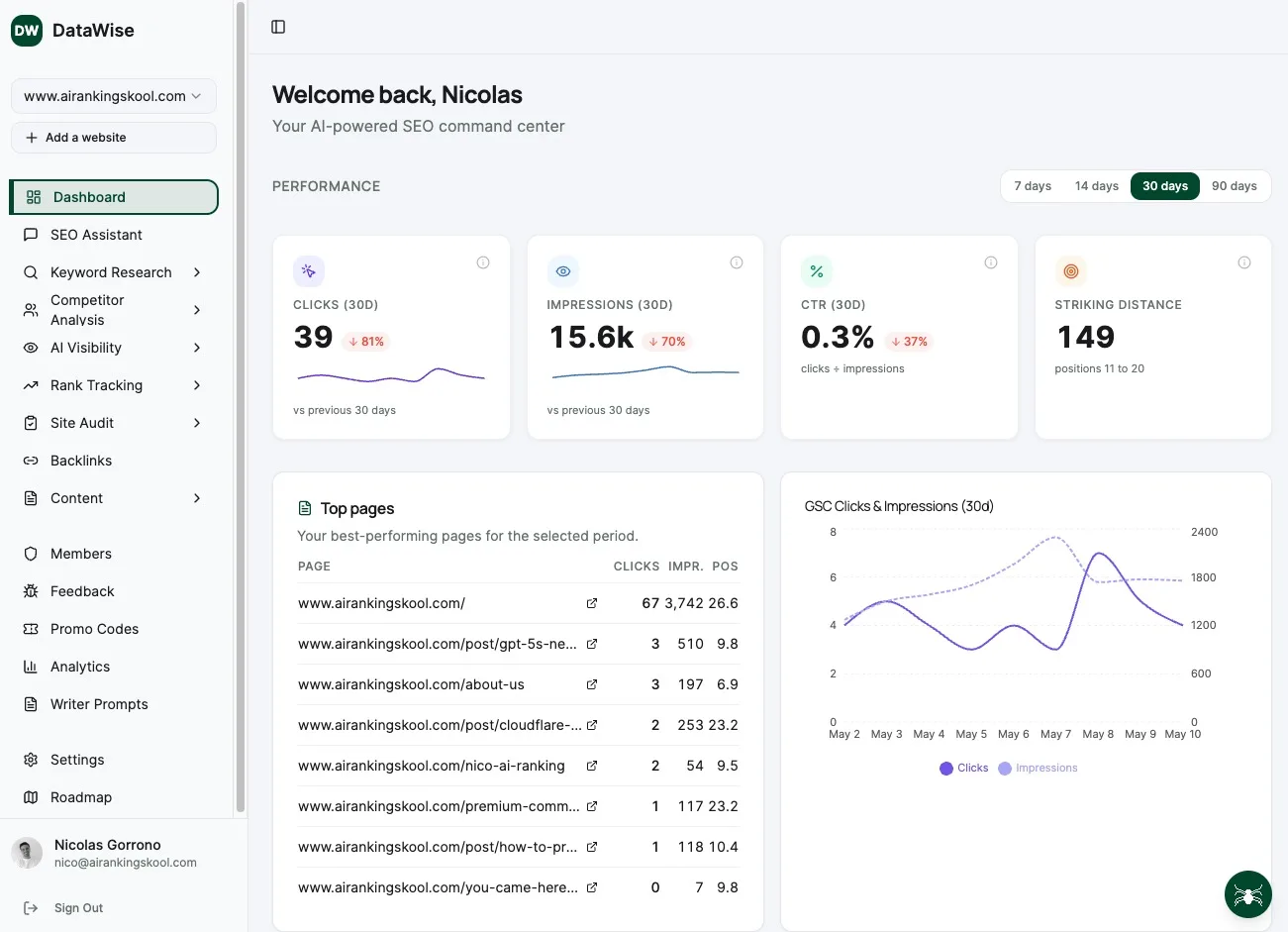
Inside AI Ranking we use DataWise, free for members. It handles keyword research, audits your draft against the target query, and scores whether your content is structured to be cited by AI search engines, not just ranked in Google. That AI-citation check is what most SEO tools miss.
AI-assisted SEO content writing
Can ChatGPT write SEO content?
ChatGPT can write SEO content, but not on its own. It is excellent for outlines, first drafts, rewriting and brainstorming angles, and it speeds up the whole process. What it cannot do reliably is original research, fact-checking, or judging search intent for your specific market. The winning workflow is AI for the draft, you for the strategy, facts, examples and final edit. That is the core of AI content writing.
Writing SEO content that gets cited by AI search
Here is the wedge competitors miss: in 2026, SEO content writing also means writing for answer engines. When someone asks ChatGPT, Perplexity or Google AI Overviews a question, those systems quote a few sources. To be one of them, lead each section with a direct, quotable answer, use clean headings, lists and tables, add real authority, and make sure AI crawlers can read your page. This practice is called generative engine optimization or answer engine optimization. Go deeper in our GEO guide and AI content optimization guide.
Our main system: build a personalized SEO copywriter (custom GPT)
This is how we actually run SEO content. Instead of prompting a blank ChatGPT every time and getting generic output, you build a custom GPT "project" once. You feed it three files about you, and from then on every draft sounds like you, weaves in your real experience and internally links to the right pages on your site. It is the difference between regurgitated AI slop and content that ranks.
A blank LLM has no context, so it gives you the average of the internet: the same angle everyone else publishes. Search intent is only half the job. The other half is the unique context and value only you can add, your wins, your data, your point of view. A project-based custom GPT solves this because it remembers that context across every post, and it gets better the more you feed it. The more you use it, the more of your knowledge it incorporates.
Done right, this beats generic AI writers like Jasper or Copy.ai, because those tools optimize for fluent output, not for your voice, your experience or your internal links. Take the ten minutes to build the files properly, the output is worth it.
The three files that make it sound like you
Create each of these as its own document and keep the exact file names, the project instructions refer to them by name.
- Tone of voice doc (
tone_of_voice_doc). Take one piece of writing you are proud of that genuinely sounds like you (a LinkedIn post, a blog post, ideally 200 to 500+ words) and have an LLM distill it into a short brand-voice guide: how you phrase things, your rhythm, words you use and avoid. Read it and edit anything you disagree with before saving. - Site link map (
website_sitemap_doc). This is essentially an llms.txt file: a list of your important URLs, each with a one-line description of what the page covers. This is what lets the GPT internally link to the correct page while it writes, a core SEO signal. You can generate one quickly with Writesonic's free llms.txt tool, then trim it to the pages that matter. - Experience doc (
experiences_doc). Your wins, results, case studies and hard-won insights, the first-hand experience AI cannot fabricate. We keep ours as a running file of community member wins, each with a short summary and the full story. If typing it all out is daunting, dictate it into a transcription tool (Otter AI or similar) and paste the text in.
The instructions (the prompt)
The fourth piece is the project's instructions: a clear prompt that tells the GPT how to write, names your company and target audience, and tells it to ask you a few questions before drafting rather than guessing. Good instructions make it ask for the post type, primary and secondary keywords, which experiences to pull in, the audience, the internal link target and the word count first, so the draft comes back close to right.
How it writes once it is set up
Give it a topic and it interviews you first, then drafts in a canvas so you can refine section by section instead of accepting a wall of text. Because it has your three files, it suggests the right wins to cite ("use William and Steven's stories, they relate to local SEO"), proposes the correct internal link from your site map, and writes in your voice. If a section is thin, ask it to expand on a specific experience and it pulls more detail from your doc.
AI drafts love the em dash and a handful of giveaway phrases. Add a negative keyword list to your project instructions (em dashes, "in today's fast-paced world", "unlock", "delve") so the GPT avoids them from the start, instead of you editing them out of every post.
One caveat: publishing is not the finish line. A great post still needs internal links pointed at it, distribution and the occasional refresh. The system gets you a genuinely good, on-brand draft fast, your job is the strategy, the facts and the final human edit.
Build your copywriter GPT with us
- The exact project instructions (the prompt) and the tone-of-voice and experience file templates.
- DataWise to build your site link map and check whether each draft is citable.
- Live feedback on your project setup and your real posts in the twice-weekly Q&A.
How we teach SEO content writing
AI Ranking is a community and course founded by Nico Gorrono that teaches business owners and marketers how to write content that ranks in Google and gets cited by AI search. There is an SEO content writing course element inside, plus prompt templates, the editing framework, DataWise, and direct feedback on your own pages.
If you want a system instead of scattered tips, join the community and start publishing content that earns traffic and citations.
Learn AI Content Writing hands-on inside the community
Courses, live calls and DataWise to optimize every draft against the live SERP before you publish.