- Programmatic SEO combines one page template with a structured dataset to publish many targeted pages at scale.
- It works for repeatable, intent-rich patterns: location pages, comparisons, directories and integration pages.
- The biggest risk is thin content: aim for at least 50% unique content per page, or Google marks them "Crawled, currently not indexed."
- In 2026 the edge is building programmatic pages that AI search will cite, with direct answers, entity coverage and per-template schema.
Programmatic SEO is the practice of creating many targeted pages at scale by combining a single page template with a structured dataset, so one template can generate hundreds or thousands of pages that each target a specific long-tail query. Think of Zapier's app-integration pages or Tripadvisor's restaurant listings: same template, different data on each page.
This guide is part of our AI SEO hub. We cover what programmatic SEO means, how it works, real examples, a step-by-step workflow, the risks that get sites deindexed, and the part competitors skip: building programmatic pages engineered to be cited by AI Overviews, ChatGPT and Perplexity.
What is programmatic SEO?
Programmatic SEO means generating pages automatically from a template and a database instead of writing each one by hand. You define a head term plus modifiers (for example "[tool] integration" or "things to do in [city]"), build one template with variable slots, then feed in a dataset so each row becomes its own page targeting a unique long-tail keyword.
How programmatic SEO works (template + dataset)
The mechanics are simple: a page template holds the fixed structure (title tag, H1, meta description, body sections, internal links) with variables, and a structured dataset (a Google Sheet, Airtable, CSV, SQL database or API) supplies the unique values for each page. A build step merges the two, generating one URL per record with its own slug and on-page elements.
Programmatic SEO vs traditional SEO
Programmatic SEO is a way of producing pages at scale; it is not a different kind of SEO. Traditional SEO usually means hand-crafting individual pages. Programmatic SEO automates the production of many similar pages from data. It overlaps with technical SEO because indexation, crawl budget and internal linking all matter more when you publish hundreds of pages at once.
Real programmatic SEO examples
- Zapier app directory: a page for every app-to-app integration, generated from their integrations database.
- Nomad List city pages: one page per city, populated with cost, weather and internet data.
- Tripadvisor: directory pages for restaurants and hotels by location, driven by their listings dataset.
- Wise currency pages: a page for each currency conversion pair, fed by live rate data.
Page types that scale
Programmatic SEO suits repeatable, intent-rich patterns: location and city pages, comparison pages ("X vs Y"), directory and app-directory pages, and integration pages. The common thread is a query pattern people search in many variations, paired with data that genuinely differs per page.
How to do programmatic SEO (step by step)
- Find keywords that scale: identify a head term plus modifiers that people search in many variations. Our keyword research guide covers finding scalable patterns.
- Collect and structure your data: gather the values for each page into a Google Sheet, Airtable, CSV or database. Sources include APIs (Google Places, Weather), scraping, or public datasets.
- Build the page template: design one template with variable slots for the title tag, H1, meta description, body and internal links, plus a unique core section per page.
- Choose a platform: WordPress with WP All Import, Webflow CMS, Softr, or a no-code build with Zapier. Pick what your team can maintain.
- Generate, QA, and publish at scale: merge data into the template, spot-check pages for quality and uniqueness, then publish and submit an XML sitemap.
AI can speed up steps 2 and 5: generating dataset values and writing the unique copy per page. Keep an editor in the loop, see AI content writing for doing this without producing thin pages.
Risks and how to avoid them
Be honest with yourself before you start: programmatic SEO can absolutely work, but it is risky. The thing that decides whether it pays off or backfires is simple: are you adding enough genuine value to each page, or just swapping the location in the title? Google's guidance is clear that scaled pages with no real value get filtered, so this is the risk to manage above all others.
The 50% rule
The bar we hold to: the content on each page should differ by at least 50% from every other page in the set, not just the title tag, the H1 and a city name. You can earn that difference with genuinely different data, local detail, examples, FAQs and media. If you do not, the pages compete with each other and Google decides they are not worth indexing.
This is the status you will see in Google Search Console when your pages are too thin. It is Google's passive-aggressive way of saying it read the page and understood the content, but decided it just is not good enough to include. If you see it across a programmatic set, the fix is almost always the same: make each page genuinely different (aim for that 50%-plus), add real value, and prune or merge the pages that cannot justify their own existence.
- Thin content: make each page differ at least 50% from the others (unique data, local detail, insights, media), not boilerplate with a swapped variable.
- Indexation and crawl budget: publish in batches, keep a clean sitemap, and internally link pages so they get discovered.
- E-E-A-T: attach a real author and sources; show the data is accurate and maintained.
Is programmatic SEO dead in 2026?
No, programmatic SEO is not dead in 2026, but the bar is higher. Low-effort, thin programmatic pages no longer work, while data-rich pages that answer a specific intent still rank and now get cited by AI search. The technique is alive; the lazy version is not.
Programmatic SEO for AI search
Programmatic SEO works for AI search when each templated page is built to be cited, not just to rank. Because AI Overviews, ChatGPT and Perplexity extract direct answers, your template should answer the page's core question in the first sentence, cover the entities a complete answer needs, and carry schema on every generated page. Done this way, a programmatic page set becomes a citation engine across thousands of long-tail queries.
Making programmatic pages citable
- Direct answer in the template: lead each page with a one-sentence answer using the page's variables.
- Entity coverage: include the related facts and terms a model expects for that topic.
- Per-template schema: bake JSON-LD (FAQPage, WebPage) into the template so every page ships it.
This is generative engine optimization applied at scale, see our GEO guide for the citation fundamentals.
Best programmatic SEO tools and DataWise
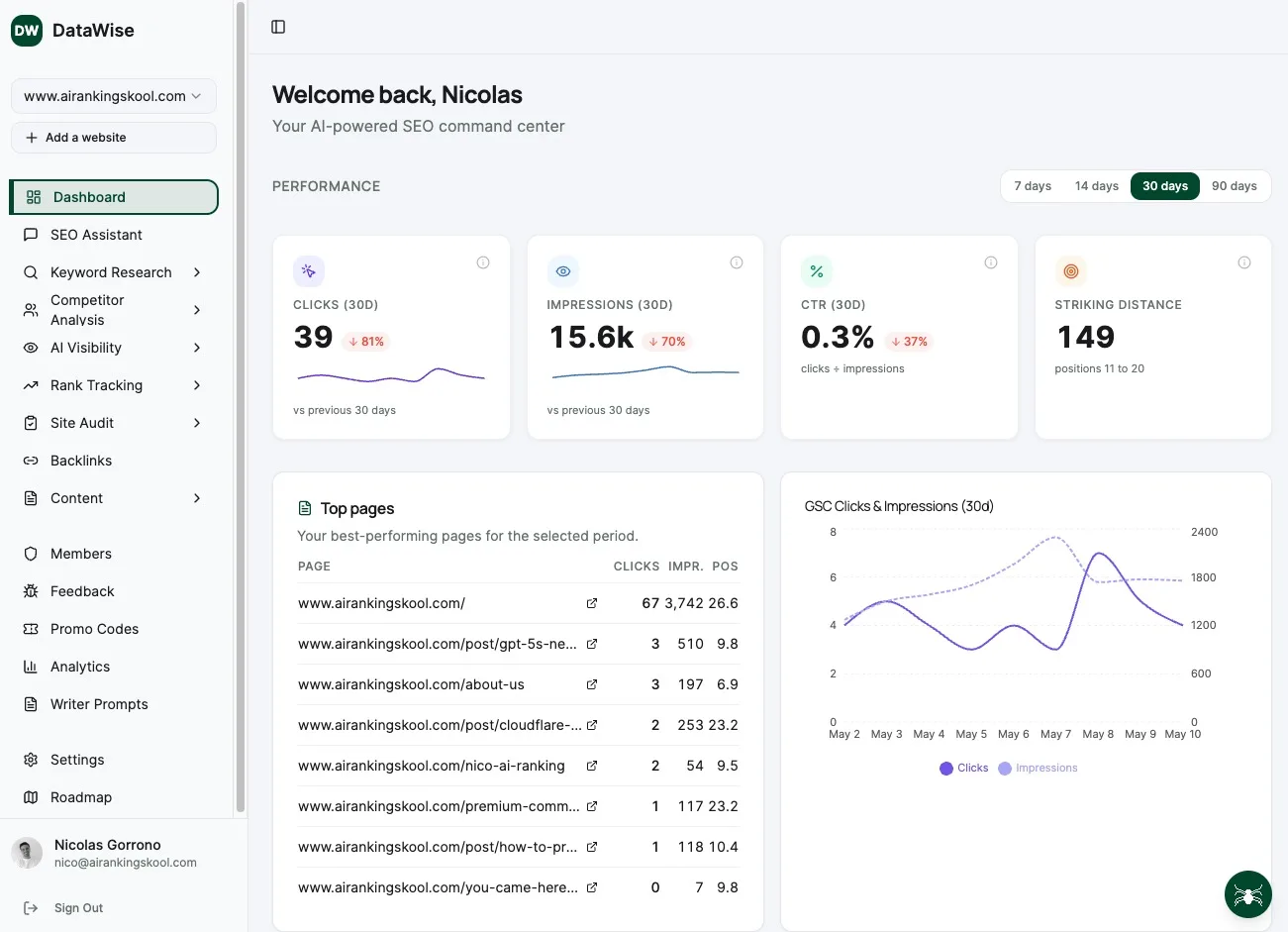
The best programmatic SEO tools cover three jobs: data (Google Sheets, Airtable, BigQuery), generation (WordPress + WP All Import, Webflow CMS, Softr, Zapier), and quality control. For the broader AI-assisted stack see the best AI SEO tools. Quality control at scale is mostly a manual discipline: spot-check pages for genuine differentiation before and after you publish. Our tool DataWise (free for members) helps on the local side: it audits an individual localized page and tells you whether it needs more work to compete, so you can catch weak location pages one at a time before they drag the whole set down.
How we teach programmatic SEO inside the community
Programmatic SEO is easy to get wrong and powerful when done right, so the AI Ranking community walks through real builds: choosing scalable patterns, structuring the dataset, designing a citable template, and QA at scale, with DataWise included free to keep quality high.
Learn AI SEO hands-on inside the community
Courses, live calls and DataWise to automated site audits + content optimization in one click.