- An SEO AI agent is an autonomous AI system that plans and executes multi-step SEO tasks with minimal supervision, not just a single tool you prompt.
- Agents run the full pipeline: research, strategy, creation, optimization, publishing and monitoring.
- You can build one with Claude Code (skills, subagents and MCP) and even run it unattended on a schedule, or buy a packaged agent.
- The 2026 edge is agents tuned for AI search: they monitor citations and update content to stay cited by ChatGPT, Perplexity and Gemini.
An SEO AI agent is an autonomous AI system that plans and carries out multi-step SEO tasks (research, content creation, optimization, publishing and monitoring) with minimal human supervision. Unlike a single AI tool you prompt once, an agent decides what to do next, uses tools and data on its own, and works toward a goal across many steps.
This guide is part of our AI SEO hub. We cover what makes a system agentic, the agentic SEO workflow stage by stage, real examples, how to build vs buy one (Claude Code skills, subagents and MCP), how to run agents autonomously on a schedule, the best agents to use, and the differentiator: agents that get you cited in AI search, not just ranked in Google.
What is an SEO AI agent?
An SEO AI agent is software that uses a large language model to reason through an SEO goal and take the steps needed to reach it, calling tools, pulling data, and making decisions along the way. Give it a goal like "keep our pricing page competitive" and it can research competitors, draft updates, check on-page elements and flag the result for review, all without you directing each step.
Agent vs tool: what makes it agentic
The difference between an AI agent and an AI SEO tool is autonomy and planning. A tool does one thing when you ask (an AI writer drafts when prompted). An agent is goal-driven: it breaks a goal into steps, chooses which tools to call, reacts to what it finds, and loops until the goal is met. Multi-agent systems go further, with specialized agents (a researcher, a writer, an editor) coordinated by an orchestrator.
Do AI agents replace SEO professionals?
No, SEO AI agents do not replace SEO professionals, they augment them. Agents excel at the repetitive, multi-step grind (monitoring, updating, drafting, auditing) but still need humans to set strategy, supply real expertise, and approve output. The strongest setup is a human directing agents and reviewing their work at quality gates.
The agentic SEO workflow, stage by stage
A capable SEO agent setup covers the same pipeline a human team would, end to end:
- Research: pull SERP data, keywords, competitor pages and questions.
- Strategy: cluster topics, map intent, and prioritize what to build or fix.
- Creation: generate briefs and first-draft content from the research.
- Optimization: check on-page elements, internal links, schema and entity coverage.
- Publishing: push to the CMS (via API) once a human approves.
- Monitoring: watch rankings, content decay and AI citations, then loop back to update.
SEO AI agent examples
- Topical authority builder: finds gaps in a cluster and drafts the missing pages.
- Content decay detector: spots pages losing traffic and queues refreshes.
- Content updater: rewrites outdated sections and stats on a schedule.
- Internal-link agent: suggests and inserts relevant internal links across the site.
- CRO agent: tests and proposes on-page changes to lift conversions.
MCP: how agents get tool access
The Model Context Protocol (MCP) is the standard that lets AI agents connect to external tools and data sources in a consistent way. With an MCP server for, say, Google Search Console or a SERP API, an agent can call that tool directly through a defined interface instead of you wiring a one-off integration. MCP, plus markdown skill files that teach an agent your process, is the modern backbone of practical SEO agents.
ROI: time and cost saved
The payoff is time. Tasks that took a team hours (a competitive content audit, a batch of brief generations, a site-wide internal-link pass) run in minutes once an agent is set up. You spend your hours on strategy and review instead of execution.
Build vs buy: how to set up an SEO AI agent
You can build your own agent or buy a packaged one. Building gives you control and lower running costs; buying gets you started faster.
- Build with Claude Code (recommended): define your SEO process as markdown skill files, add specialized subagents (a researcher, a writer, an editor), and give them tool access via MCP (Search Console, DataForSEO, your CMS). This has become the most capable and flexible way to build SEO agents.
- Run it on a schedule: with headless mode and a cron job, the same agent runs unattended on whatever cadence you set, with no separate platform required. See the autonomous section below.
- Buy: packaged agents from SEO platforms handle setup for you, at a higher monthly cost and less flexibility.
No-code builders like n8n, Make and Gumloop can still wire workflows together, but for SEO agents specifically we have moved away from them: the Claude Code approach (skills, subagents, MCP and scheduling) has overtaken them on capability, flexibility and cost. To scale the page generation an agent can feed, see programmatic SEO.
Autonomous agents that run on a schedule
The real unlock is not running an agent once, it is having it run itself. With Claude Code you can take an agent you already built and put it on autopilot, so it does the work while you do nothing.
Two pieces make this work. Headless mode lets Claude Code run in the background without you sitting in a terminal. A cron job schedules it to run on its own at set times. Once an agent works in a normal conversation, you simply tell Claude to run it as a cron job on whatever cadence you want. For example, a video-to-blog agent that turns each new YouTube video into an internally-linked, FAQ-equipped post and publishes it can run automatically every Tuesday and Thursday at 9am, with no input from you.
For SEO this is where it gets powerful. Schedule a weekly content-decay scan, a monthly internal-link pass, a recurring competitor-and-citation check, or an automated content refresh. The agent wakes up on schedule, does the work through its MCP connections, and leaves you the result to review.
Scheduled jobs need permission to run. In System Settings > Privacy & Security > Full Disk Access, add cron: press the plus, then Cmd+Shift+G and enter /usr/sbin/cron. Do this once and your scheduled agents run reliably.
One catch: headless, scheduled runs are invisible, so it is easy to lose track of what actually ran. Build yourself a simple command-center dashboard that shows your scheduled jobs, which project each belongs to, when it last ran, and whether it succeeded. We share a starting prompt for this inside the community.
Best AI agents for SEO (free vs paid)
The best AI agents for SEO depend on whether you want to build or buy. On the build side, Claude Code (with skills, subagents and MCP) has become the most capable way to build custom SEO agents, and it can run them on a schedule. On the buy side, platforms like Otto AI (Search Atlas), Frase and Surfer are adding agentic features, and research tools like Semrush and Ahrefs supply the data agents run on. For a full comparison, see the best AI SEO tools.
Are there free SEO AI agents?
Effectively yes: with a Claude Code subscription you can build agents from markdown skills and MCP connections, and even schedule them, with no separate automation platform to pay for. Inside the community we share ready-made agent templates, skills and MCP configs so you do not start from scratch.
SEO AI agents for AI search (GEO)
SEO AI agents help you get cited in AI search by monitoring where you appear in AI answers and updating content to stay citable. An agent can track your mention share across ChatGPT, Perplexity and Gemini, detect pages that lost citations, and rewrite them to answer questions directly with the right entity coverage and schema. That dual SEO-plus-GEO scoring is the modern edge, and it is the core of generative engine optimization.
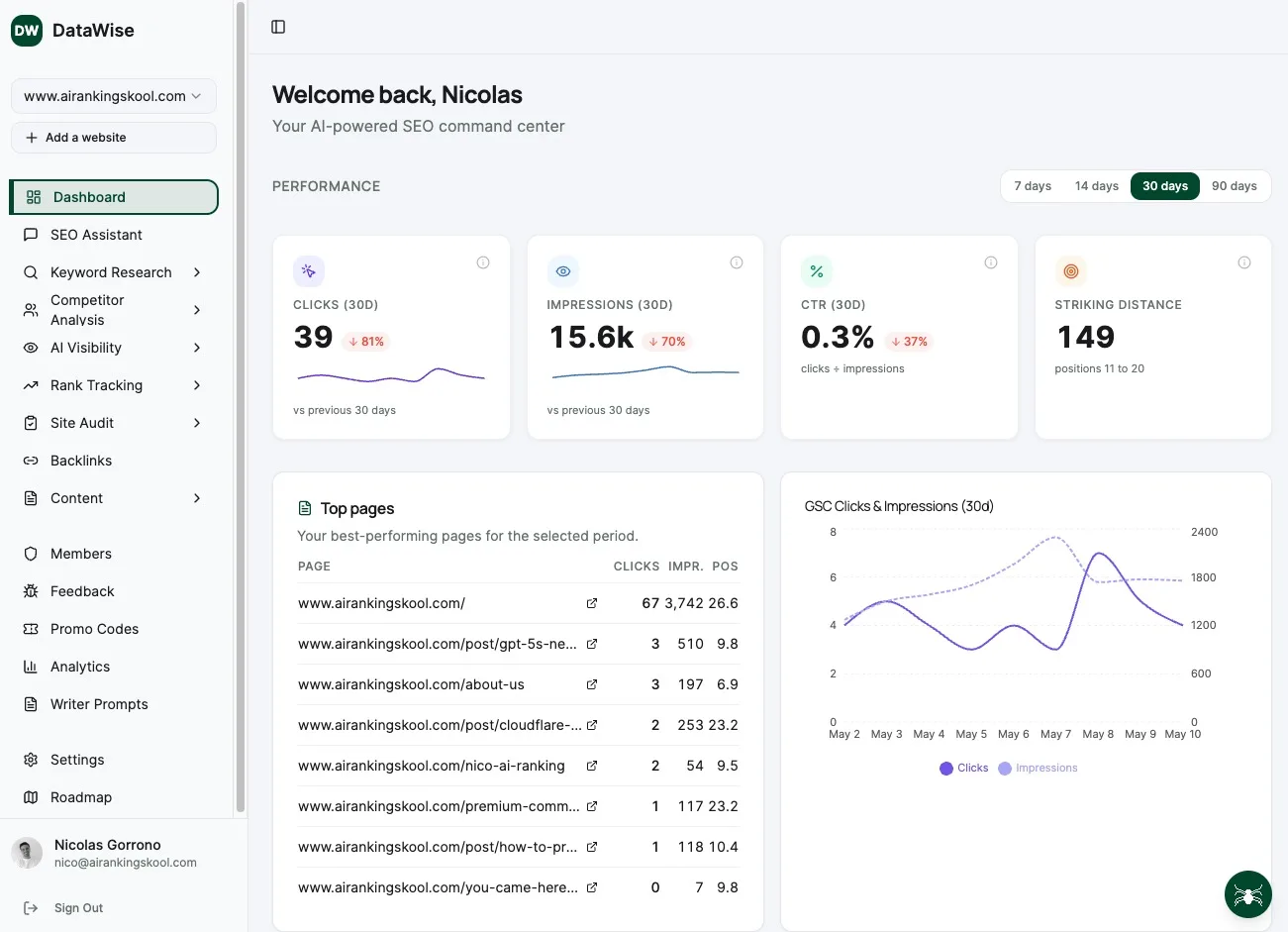
Our tool DataWise (free for members) is the citation layer for your agents: it scores AI visibility and citation readiness, giving the agent a clear signal of what to fix.
"SEO for AI agents" vs "SEO AI agents"
These two phrases mean different things. "SEO AI agents" are agents that do SEO work for you (the subject of this guide). "SEO for AI agents" means making your own site readable to the AI agents and crawlers that browse the web on users' behalf, so they can find and quote your content. The second is really a GEO concern, covered in our GEO guide.
How we teach SEO AI agents inside the community
Setting up agents is where most people stall, so the AI Ranking community ships the actual building blocks: agent and subagent templates, the prompts and skill files, the MCP setups, and the cron schedules our members run in production. Pair that with DataWise free, and your agents optimize for AI citations, not just rankings.
Learn AI SEO hands-on inside the community
Courses, live calls and DataWise to automated site audits + content optimization in one click.