- AI keyword research uses large language models to generate, expand, cluster and classify keywords faster than manual methods.
- AI is excellent for ideas and structure but does not know real search volume or difficulty, so every suggestion must be validated with data.
- The biggest payoff is researching the questions and entities AI search engines cite, so your pages appear in AI Overviews, ChatGPT and Perplexity.
- You can connect ChatGPT to live SEO data with a custom GPT plus DataForSEO, getting real volume and difficulty for a fraction of a subscription tool's cost.
AI keyword research is using AI tools and large language models to generate, expand, cluster and classify keyword ideas faster than you could by hand. You give an AI a seed topic and it returns hundreds of related keywords, questions and intent groupings in seconds, which you then validate against real search data before committing.
This guide is part of our keyword research hub. We cover what AI keyword research is, how to do it step by step, the best AI tools, why you must validate AI suggestions, copy-paste prompts, and the differentiator most guides miss: how to research for getting cited by AI search engines.
What is AI keyword research?
AI keyword research is the use of artificial intelligence, mainly large language models like ChatGPT, Claude and Gemini, to speed up keyword discovery: brainstorming seeds, expanding them into long-tail variants and questions, clustering by topic, and classifying search intent. It compresses hours of manual spreadsheet work into minutes.
AI vs traditional keyword research
Traditional keyword research relies on tools that report real metrics: search volume, keyword difficulty and SERP data. AI keyword research adds speed and scale on the creative side (ideas, clustering, intent), but AI does not measure live search demand. The two are complementary: AI for breadth and structure, traditional tools for the hard data that decisions depend on.
How to do AI keyword research (step by step)
A reliable AI keyword research workflow has four steps:
- Generate ideas from seed topics: give the LLM your niche and ask for keyword ideas, questions and subtopics.
- Cluster keywords by topic and intent: ask it to group the list into clusters that share intent.
- Classify search intent: have it tag each keyword as informational, navigational, commercial or transactional.
- Find long-tail keywords at scale: prompt it for specific, conversational variants and questions.
These steps build on the fundamentals: see our how to do keyword research guide for the manual process, and the keyword research pillar for clustering the AI output, tagging intent, and turning the list into pages.
Best AI keyword research tools
Dedicated AI SEO tools
Established SEO platforms now bake AI into keyword research: Semrush, Ahrefs, Surfer SEO and Moz Pro layer AI clustering and intent on top of their real data, while tools like LowFruits and Nightwatch focus on low-competition discovery and tracking. These pair AI convenience with the volume and difficulty data that LLMs lack.
Can ChatGPT, Claude and Gemini do keyword research?
ChatGPT, Claude and Gemini can do the creative half of keyword research well: generating ideas, questions, clusters and intent labels. What they cannot do out of the box is tell you real search volume or keyword difficulty; they will generate plausible-looking numbers that are simply made up. Use them for ideation, then move the list into a tool with live data, or connect ChatGPT to live data directly with a custom GPT (see the next section).
Turn ChatGPT into a real keyword tool (custom GPT + DataForSEO)
ChatGPT does not have SEO data out of the box, which is why it invents volume and difficulty. But you can give it that data. By connecting a custom GPT to DataForSEO, ChatGPT pulls real keyword metrics, competitor rankings and on-page data live, for a fraction of the cost of a Semrush or Ahrefs subscription.
How the connection works
DataForSEO is a pay-as-you-go SEO data API: you only pay when you make a call, often a fraction of a cent each, and a free sign-up credit gets you started. To wire it up: create a custom GPT (this needs a paid ChatGPT plan), turn on code interpreter and data analysis, then add a custom action and paste in the DataForSEO API schema (the public GitHub repo has a ready-made JSON file for each tool). Under Authentication, choose API key and paste your DataForSEO login and password base64-encoded, so your credentials stay hidden even if you share the GPT. ChatGPT asks you to confirm each data call, which is a normal security step.
Build one GPT per job
A single GPT cannot hold every DataForSEO call without overloading, so build a focused GPT per job and paste only that tool's schema. If you want one GPT that does the most, the DataForSEO Labs schema is the most versatile.
Three custom GPTs worth building
- Keyword growth analyzer: feed it a topic and it returns winnable keywords with real volume, difficulty and cost-per-click.
- On-site SEO fixer: give it a URL and it crawls the page and returns a prioritized list of technical and on-page fixes, with context a generic tool misses because it is ChatGPT reading your actual content.
- Competitor keyword spy: give it a competitor's domain and it lists the keywords they rank for, so you can find the gaps worth targeting (use the DataForSEO Labs schema for this one).
You can even @-mention one of these custom GPTs inside a normal ChatGPT chat to verify volumes or competition while you draft, without leaving the conversation. Because you only pay per call, a full research session can cost pennies. We share the exact prompts that turn these GPTs into a competitor analyzer and keyword planner inside the community.
Building and maintaining custom GPTs is powerful but fiddly. DataWise (free for members) gives you the same live-data-plus-AI workflow out of the box: real volume and difficulty, AI clustering and intent, and AI-Overview opportunity scoring, with nothing to wire up.
Validate AI keyword suggestions before you commit
Never publish based on raw AI output. Always validate AI keyword suggestions against real data: check actual search volume, keyword difficulty and the live SERP for each term before you build a page. AI is a brainstorming partner, not a source of truth for metrics. Then feed your published pages into rank tracking and loop the results back into your research.
Common AI keyword research mistakes
- Treating AI output as final instead of a draft to validate.
- Trusting invented volume or difficulty numbers from an LLM.
- Ignoring search intent and SERP reality when grouping keywords.
- Targeting keywords with no proven demand because the AI 'suggested' them.
Copy-paste AI prompts for keyword research
Good prompts make AI keyword research far more useful. Start with these and swap in your own topic:
Seed expansion:
"List 50 keyword ideas and questions a [your audience] would
search around [topic]. Group them by subtopic."

Intent classification:
"Classify each of these keywords as informational,
navigational, commercial, or transactional: [paste list]."

Clustering:
"Cluster these keywords into groups that share search intent
and could be covered by a single page: [paste list]."

Question / fan-out research:
"List the sub-questions someone asking '[main query]' would
also want answered, as I want one page to cover all of them."
The last prompt is the one most people miss: it surfaces the sub-questions AI engines fan out into, which is the bridge to the next section.
AI keyword research for AI search (GEO and AEO)
The biggest reason to do AI keyword research is to get cited by AI search itself. AI Overviews, ChatGPT and Perplexity answer questions by quietly breaking a prompt into many related sub-queries (query fan-out) and pulling from pages that answer each one clearly. So a core part of AI keyword research is mapping those fan-out queries: list every sub-question and entity an answer should cover, then build pages that answer them directly. Cover more of a topic's fan-out than your competitors and you win the citation.
This is answer engine optimization (AEO), and almost no keyword tool frames research this way. Instead of chasing one head keyword, you research the full question set and the entities a topic involves, then write to be the cited source. It is the core of AI SEO and exactly what we teach.
Yes, when you research the right way. Mapping the sub-questions and entities behind a topic, then answering each directly, is what gets a page pulled into AI Overviews and quoted by ChatGPT and Perplexity. Keyword volume alone does not.
DataWise: AI keyword research built for getting cited
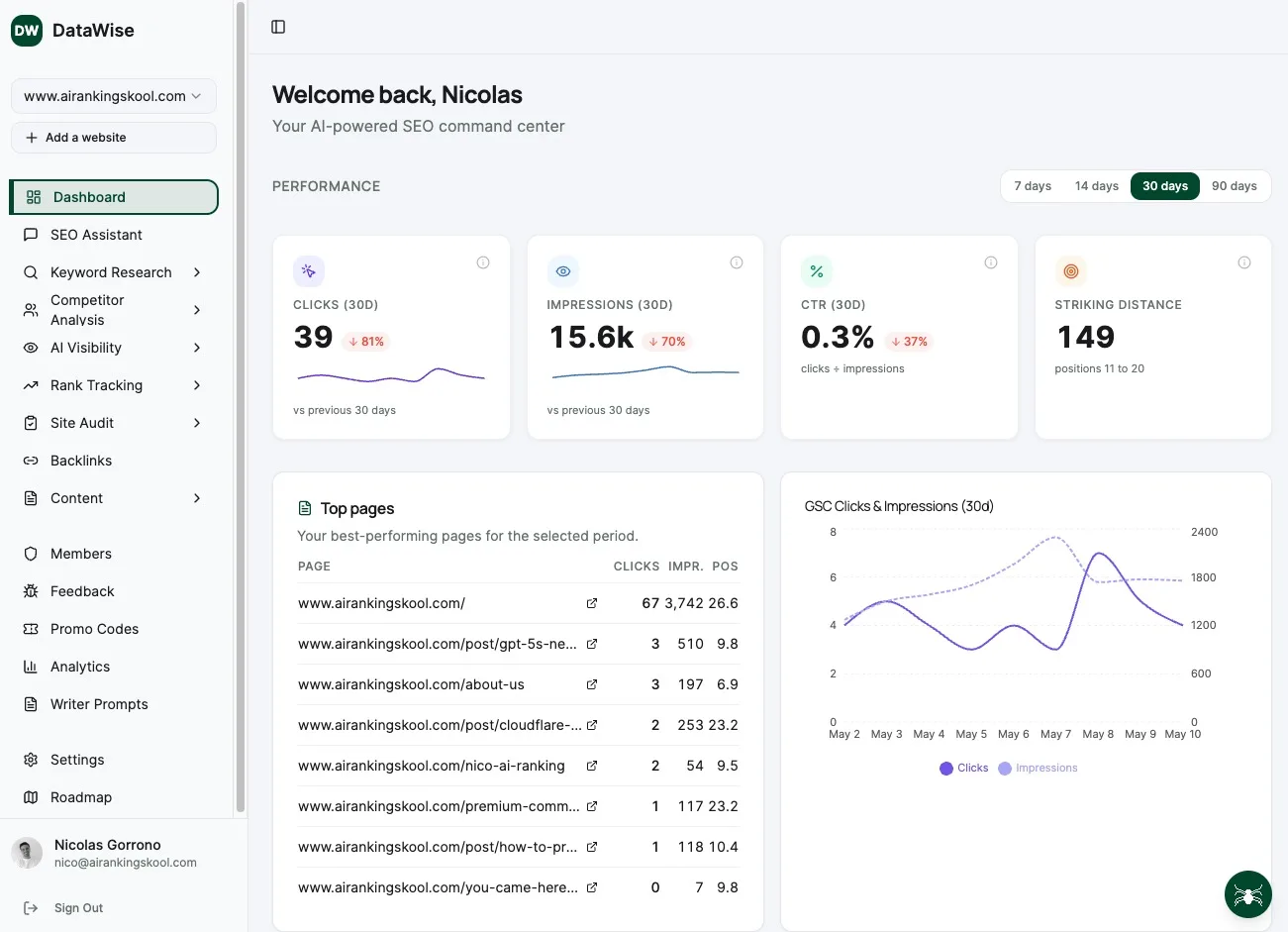
DataWise is our AI-powered keyword research tool, free for AI Ranking members. It generates and clusters keywords with AI, tags intent, validates each term with live volume and difficulty data so you never act on invented numbers, and scores keywords for AI-Overview opportunity so you can prioritize the questions worth getting cited for.
There is no separate free AI keyword tool to hunt for: members get DataWise included. Join the community to use it and learn the full AI keyword research and GEO workflow.
Learn Keyword Research hands-on inside the community
Courses, live calls and DataWise to pull volume, difficulty and clusters without juggling five tools.