- LLM SEO is optimizing your content so large language models (ChatGPT, Perplexity, Gemini, Claude) cite and recommend you.
- LLMs surface you two ways: parametric knowledge baked in at training, and live retrieval (RAG) at answer time. You optimize for both.
- It is one teachable layer of GEO: extractable content, schema, llms.txt, off-site mentions and citation monitoring.
- A unique, high-value move is auditing and fixing what AI gets wrong about your brand.
LLM SEO is the practice of optimizing your content so large language models like ChatGPT, Perplexity, Google Gemini and Claude cite, quote and recommend your business in their answers. It is SEO aimed at the AI models that now answer questions directly, instead of only at the search engines that return blue links.
LLM SEO is one discipline inside generative engine optimization (GEO). The goal is the same as classic SEO (be the trusted source) but the target changed: you are optimizing for how an LLM finds, understands and attributes your content. This guide explains what LLM SEO is, how LLMs actually pull in sources, and a practical best-practices playbook you can run.
What is LLM SEO?
LLM SEO (also called SEO for LLMs) is optimizing your content and site so large language models surface, cite and recommend your business when they generate answers. In practice that means writing clear, extractable, well-structured content that an LLM can confidently understand and attribute, then building the off-site signals that make it trust you.
LLM SEO vs traditional SEO (and how they work together)
Traditional SEO optimizes a page to rank in a results list a human scrolls. LLM SEO optimizes content to be retrieved and cited inside an AI-generated answer. They are not rivals: LLMs lean heavily on pages that already rank well and carry authority, so traditional SEO is the foundation LLM SEO is built on. You keep your technical SEO and topical authority, then add the answer-first structure and trust signals that AI models reward.
LLM SEO vs GEO vs AEO
These overlap and people use them interchangeably, but there is a clean way to hold them. GEO (generative engine optimization) is the umbrella: getting cited and recommended across all generative AI search. AEO (answer engine optimization) is the answer-focused slice. LLM SEO is the same work framed around the underlying technology, the large language models themselves. We teach all three as one system on the GEO pillar.
How LLMs find and cite content (parametric knowledge vs RAG)
LLMs surface your content two ways. First, parametric knowledge: facts absorbed during training (from sources like Common Crawl) and baked into the model's weights, which is why being widely referenced across the web matters. Second, retrieval-augmented generation (RAG): at answer time, tools like ChatGPT search, Perplexity and AI Overviews fetch live pages, then cite them. RAG citations are the faster-moving target, and the one good content structure influences most directly.
Is SEO dead? Why LLM SEO and classic SEO coexist
SEO is not dead; it is expanding. People still run billions of traditional searches, and AI engines build their answers largely from pages that already rank and are trusted. So classic SEO and LLM SEO reinforce each other: the same authority that ranks you also makes an LLM more likely to cite you. The reframe we teach is simple: do not abandon SEO, add the AI-search layer on top.
Is LLM SEO just about getting into the training data?
Partly, but not the way it is usually pitched. Getting into a model's training data does matter, but you cannot control it directly, it goes stale, and the citations you actually want are produced live. The move that works feeds both the training data and live retrieval at once, so you do not have to bet on either.
What the training data actually does
An LLM's "parametric" memory is everything it absorbed during training, baked into its weights. It is real and it matters: by most counts, more than half of ChatGPT answers are produced from this built-in knowledge without any live web search. That is how a model can name your business off the top of its head, with no browsing, when it already "knows" you. So being widely referenced across the web genuinely helps a model learn who you are.
Why you cannot just "get into the training set"
There is no form to submit your business to a training set, and parametric memory is frozen at a knowledge cutoff, so it goes stale between model releases. The only realistic lever is your public web presence. Models are trained largely on Common Crawl (it made up over 80% of the tokens behind GPT-3), and Common Crawl decides what to ingest using harmonic centrality: the more your domain is linked to across the web, the more likely it gets crawled and included. In other words, you influence training data the same way you earn authority anywhere, through mentions and links, and only on a slow, multi-model timeline.
What actually drives citations today
Live retrieval. When ChatGPT runs a web search, around 87% of the links it cites match Bing's top organic results (Seer Interactive). A clickable citation always comes from retrieval, never from memory, so being retrievable (ranking in Bing and Google, with clean, extractable pages) is what wins the citation in real time. This is the fast lever you control, while training-data inclusion is the slow byproduct.
AI visibility has two drivers, not one: training-data authority shapes which sources a model trusts, and live retrievability decides what actually gets cited right now. The strongest signal Ahrefs measured across ~75,000 brands was branded web mentions, ahead of backlinks. The good news: the same public web presence makes you retrievable today and feeds the next training run, so do not chase the training set, build the authority that feeds both.
| The myth | The reality |
|---|---|
| LLM SEO is mainly about getting into the training data | It is about public web presence that feeds both training data and live retrieval |
| If you are in the training set, models recommend you without searching | Training memory is frozen at a cutoff and goes stale; the citations you want are produced live |
| You can submit or inject your business into a model's training set | You cannot control it; you can only raise your odds of being crawled (Common Crawl favors widely-linked sites) |
| Backlinks are the top signal | Branded web mentions are the strongest measured correlate of AI visibility, ahead of backlinks |
How to do LLM SEO (the best-practices playbook)
Write conversational, context-rich, extractable content
Write the way people ask LLMs: in full, conversational questions. Answer each in the first one or two sentences, then expand. Keep paragraphs atomic and self-contained so a model can lift a passage without losing context. Include the entities, definitions and specifics (names, numbers, comparisons) an LLM needs to treat your page as a complete, citable source.
Structure for summarization: FAQs, key takeaways, schema
Make your content trivially easy to parse. Lead pages with a short key-takeaways block, use question-style H2/H3 headings, and add FAQ blocks, bullet lists and comparison tables. Mark it up with JSON-LD schema (Article, FAQPage, HowTo, Organization) so models can resolve what each passage is and who wrote it.
Use llms.txt
An llms.txt file gives AI models a curated Markdown map of your most important pages. It is cheap to add and future-friendly, though evidence that major crawlers fetch it today is still thin. Treat it as a small complement, not a magic switch. The full guide, including how to generate and validate one, is in our llms.txt spoke.
Earn brand mentions and citations off-site
LLMs learn who you are from the wider web, so your off-site footprint is part of LLM SEO. Earn mentions and presence on the sources models trust and retrieve from: Reddit, YouTube, Wikipedia, G2 and Capterra, Crunchbase, Trustpilot and Quora. Consistent, accurate mentions across these surfaces raise the odds an LLM both knows you and cites you.
Which LLMs and AI engines to optimize for
Optimize for the engines your buyers actually use: ChatGPT (and SearchGPT) via OAI-SearchBot and GPTBot, Perplexity via PerplexityBot, Google Gemini and AI Overviews via Google-Extended, and Claude via ClaudeBot, with Bing, Grok and DeepSeek in the mix. The good news: the core work (clear, structured, trusted content) travels across all of them, so you optimize once and benefit everywhere.
Measure LLM visibility (GSC, GA4, citation monitoring)
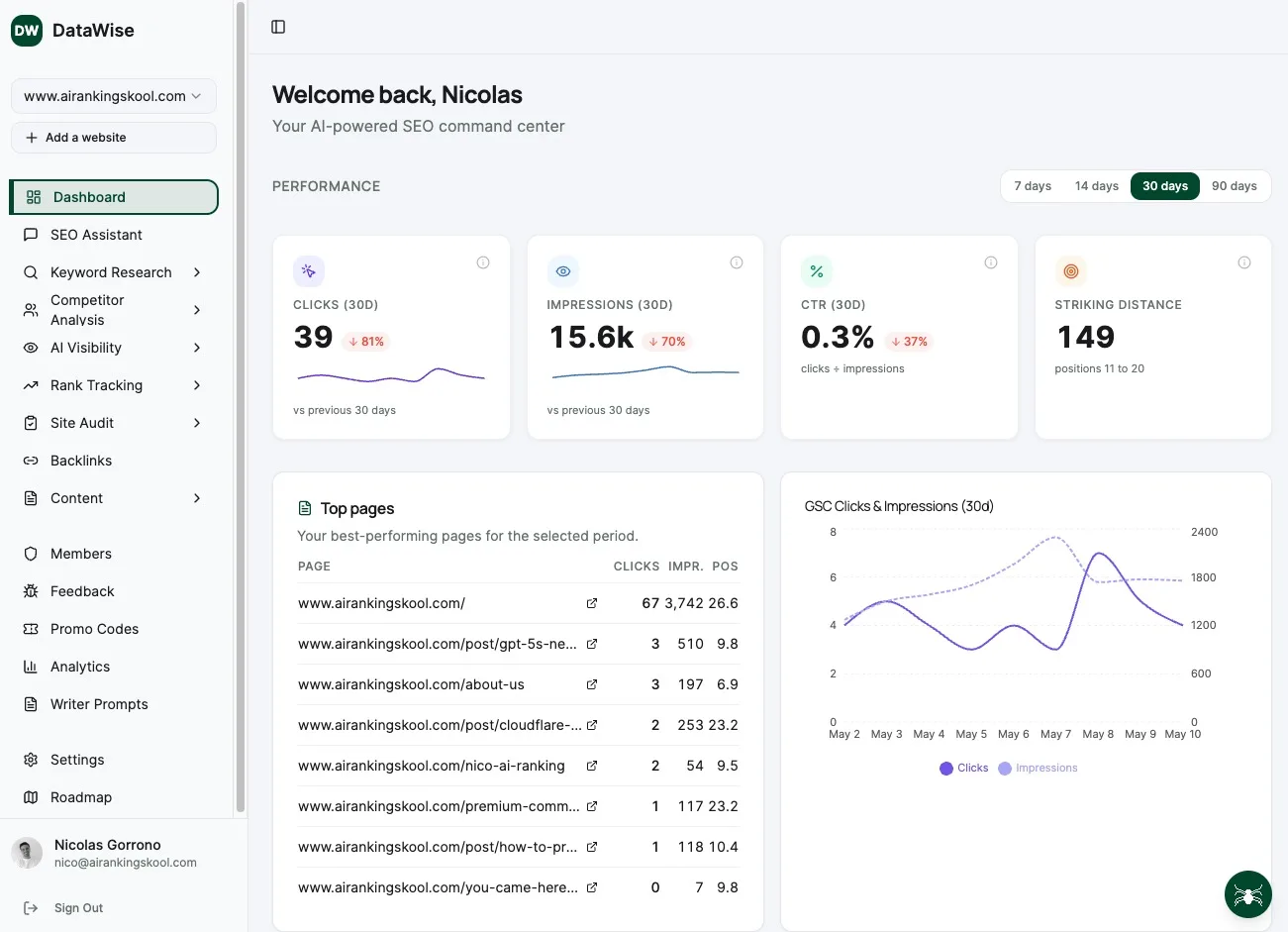
You cannot improve what you do not watch. Use Google Search Console and Bing Webmaster Tools to confirm AI crawlers can reach you, GA4 to track referral traffic from ChatGPT, Perplexity and Gemini, and a citation-monitoring tool to see which queries actually cite you. DataWise (free for members) tracks your AI visibility and citation share over time so this stops being a manual chore.
Fix what AI gets wrong about you
Here is the move most LLM SEO guides miss: auditing what AI already says about your brand and correcting it. Ask the major engines about your company and your category, and you will often find outdated facts, wrong claims, or a competitor named where you should be. Because LLMs draw on your site plus third-party sources, you fix it by publishing the correct, clearly-stated facts on your own pages and by improving the off-site sources (Wikipedia, G2, Reddit) the models lean on. We run this audit-and-correct loop with DataWise inside the community.
LLM SEO tools and DataWise
The best LLM SEO tools cover three jobs: finding the questions to answer, checking your content is structured and marked up for extraction, and monitoring whether AI engines actually cite you. Many teams stitch this together from Search Console, GA4 and manual checks in ChatGPT and Perplexity, which works but does not scale.
DataWise is our LLM SEO tool, free for community members. It monitors your AI visibility and citation share across engines and powers the "fix what AI gets wrong" audit above. If you want an LLM SEO agency or done-for-you services, our honest take is that owners get further learning the system themselves: that is what the AI Ranking community is for, and it ties into the wider AI SEO workflow.
Learn Generative Engine Optimization hands-on inside the community
Courses, live calls and DataWise to track your AI citations and AI Overview presence.