- ChatGPT SEO has two meanings: ranking IN ChatGPT (getting cited) and using ChatGPT FOR SEO work. This page covers both.
- ChatGPT sources answers via GPTBot crawling, its SearchGPT layer, and Bing's index, so being crawlable and indexed in Bing matters.
- Get cited with a 3-step playbook: be crawlable, structure content for extraction, and build mentions and E-E-A-T.
- Make it measurable: track your share of voice and citation frequency in ChatGPT over time.
ChatGPT SEO means two related things: optimizing your content so ChatGPT cites and recommends your business in its answers (the GEO meaning), and using ChatGPT as a tool to do SEO work faster (the workflow meaning). This guide leads with the first, getting cited inside ChatGPT, then covers the second.
ChatGPT is one generative engine among many, so the tactics here are a specific application of generative engine optimization (GEO). See the GEO pillar for the full framework, and the sibling guides for Perplexity and Google AI Overviews. Below is a ChatGPT-specific, measurable playbook.
Why getting cited in ChatGPT matters in 2026
ChatGPT is no longer just a chatbot. It is a search surface where hundreds of millions of people ask the buying questions you want your business to answer.
OpenAI reports ChatGPT now reaches 900 million people a week and more than 50 million paying subscribers, after roughly doubling its weekly users in a year. When one of them asks ChatGPT for the best option in your category, your business is either named in the answer or invisible. This page is about being named.
What ChatGPT SEO actually means
ChatGPT SEO, defined: it is the practice of optimizing your website and brand so ChatGPT names, cites and recommends you when users ask it questions. People also use the phrase to mean using ChatGPT for SEO tasks, so the term carries two intents; this page treats "rank in ChatGPT" as the primary meaning and folds the "use it for SEO" workflow into its own section.
How ChatGPT sources and cites answers (GPTBot, SearchGPT, Bing, IndexNow)
ChatGPT pulls answers from two places: knowledge baked in during training, and live web results retrieved at answer time through its search layer (SearchGPT). For live results, OpenAI's crawler GPTBot gathers content, and ChatGPT's web search has historically leaned on Bing's index, so your presence in Bing matters more than most people expect. Submitting URLs via IndexNow (which Bing supports) helps your fresh content get discovered quickly.
Does ChatGPT use Bing's index?
Yes, in large part. ChatGPT's web browsing and SearchGPT features have relied heavily on Bing's search index to find and rank live pages, alongside OpenAI's own GPTBot crawling. The practical takeaway: make sure your site is indexed in Bing (verify in Bing Webmaster Tools) and is not blocking GPTBot in robots.txt, or you remove yourself from ChatGPT's pool of citable sources.
GEO vs SEO for ChatGPT
Classic SEO for ChatGPT would stop at "rank well and hope." The GEO approach is more specific and measurable: optimize individual passages to be extractable, earn the brand mentions that make ChatGPT confident, then verify and track whether you are actually cited. The difference is that GEO targets the citation itself and closes the loop with measurement, rather than treating ChatGPT visibility as a lucky byproduct of rankings.
The 3-step ChatGPT SEO playbook
Step 1: Get indexed and crawlable
If ChatGPT cannot reach your content, it cannot cite you. Allow GPTBot and OAI-SearchBot in your robots.txt, keep a clean XML sitemap, and make sure your pages are indexed in both Google and Bing (ChatGPT leans on Bing). Use IndexNow to push new and updated URLs to Bing fast. This crawlable, indexed foundation is non-negotiable.
Step 2: Structure content for AI extraction
ChatGPT cites passages it can lift cleanly. Lead each section with a direct-answer sentence, use clear headings phrased as the questions people ask, keep paragraphs short and self-contained, and use bullet points, numbered lists and descriptive quotes. Back claims with statistics and case studies, and add schema markup (Article, FAQPage, HowTo) so the model can parse and attribute your content.
Step 3: Build brand mentions, citations, and E-E-A-T
ChatGPT favors brands the web already trusts. Build experience, expertise, authoritativeness and trustworthiness (E-E-A-T) with a real expert author, then earn mentions and citations on third-party sites, forums and roundups your buyers read. Each credible mention raises the odds ChatGPT both knows you exist and treats you as a safe source to cite.
Get named in ChatGPT answers, starting this week
- Allow GPTBot and confirm your pages are indexed in Bing so ChatGPT can reach you.
- Restructure one buyer-question page answer-first so it is easy to lift and cite.
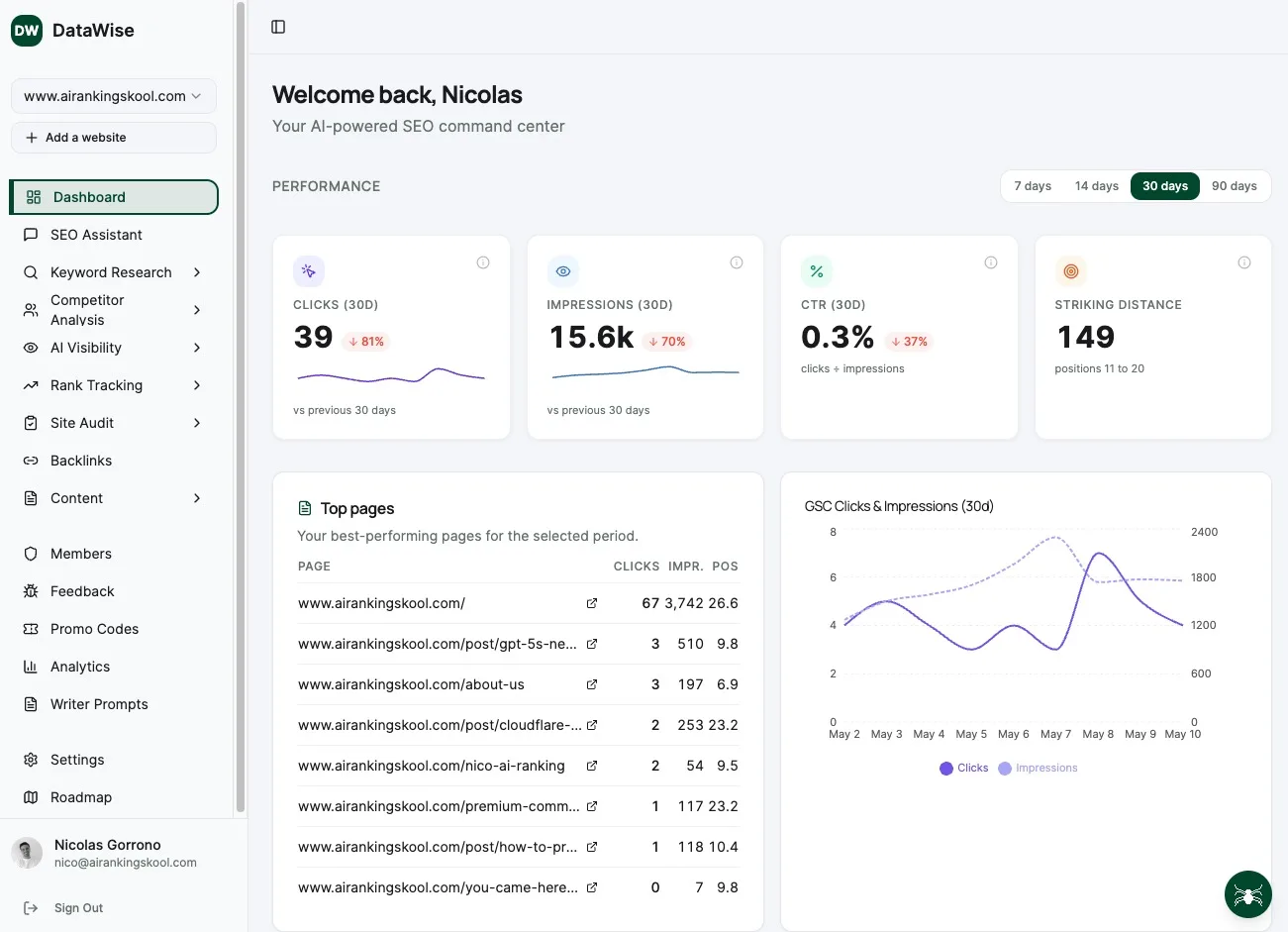
- Track your ChatGPT share of voice with DataWise, free inside the community.
How to measure ChatGPT visibility
Measure ChatGPT visibility with three signals: share of voice (how often you appear versus competitors for your key questions), citation frequency (how often ChatGPT links or names you), and sentiment (whether the mention is positive). The simplest manual method is to ask ChatGPT your real buyer questions on a schedule and log who gets cited.
Doing that by hand does not scale, which is where DataWise comes in (free for members): it tracks your citation frequency and share of voice in ChatGPT and other engines over time, so you can prove your work is moving the number instead of guessing.
Best ChatGPT SEO tools
The most useful ChatGPT SEO tools fall into two groups: visibility trackers that show how often ChatGPT cites you (share of voice and citation frequency over time), and the workflow tools you already need, Bing Webmaster Tools and Google Search Console for indexing, plus ChatGPT itself for drafting. For the visibility side, DataWise tracks your citation share across ChatGPT and other engines and is free for community members.
Using ChatGPT as an SEO assistant
Beyond ranking in ChatGPT, you can use ChatGPT for SEO work: clustering keywords, drafting briefs and outlines, generating FAQ and schema, writing meta titles and descriptions, and turning research into first drafts. It is a fast assistant, not a strategist, so the rule is to feed it real data and verify everything it produces.
Best ChatGPT SEO prompts
Cluster these keywords by search intent and topic, then
name the pillar page and the spoke pages:
[paste keyword list]

Write an answer-first intro for a page targeting
"[keyword]". First sentence must directly answer the
query in under 30 words. Plain English, no fluff.

Generate FAQPage JSON-LD for these 5 questions and
answers: [paste Q&As]

List the sub-questions a user asking "[query]" also
wants answered, so I can cover the full topic.
The risk: AI content quality and Google
Publishing raw, unedited ChatGPT output is the fastest way to hurt yourself. Google rewards helpful, accurate content regardless of how it was made, but it penalizes thin, generic, unverified text, and that is exactly what unedited AI tends to produce. Use ChatGPT to accelerate drafts, then add real expertise, verify facts, and make it genuinely useful before publishing.
Will ChatGPT replace SEO?
No, ChatGPT is not replacing SEO; it is changing where the visibility happens. SEO is shifting from "rank a page" to "get cited in answers," but the underlying work (be crawlable, be useful, be trusted) is the same discipline evolving. ChatGPT even depends on the indexed, ranking web to source its answers, so SEO and ChatGPT SEO grow together. We teach both as one connected system in the AI Ranking community.
Learn Generative Engine Optimization hands-on inside the community
Courses, live calls and DataWise to track your AI citations and AI Overview presence.