- Answer engine optimization (AEO) is optimizing content so AI answer engines (ChatGPT, Perplexity, Google AI Overviews, Gemini, Copilot) cite and recommend you.
- AEO is the answer-focused subset of GEO: structure content answer-first, add schema, and build trust signals.
- The win is measurable: verify you are actually being cited, then track your citation share over time.
- Tools help, but the durable advantage is clear, accurate, well-structured content from a real, trusted author.
Answer engine optimization (AEO) is the practice of structuring your content so AI answer engines like ChatGPT, Perplexity, Google AI Overviews, Gemini and Microsoft Copilot quote, cite and recommend your business when they answer a question. Instead of fighting for a blue link, you optimize to be the source the AI pulls its answer from.
AEO is the answer-focused part of generative engine optimization (GEO). The mechanics are practical: answer the question directly and early, format content so it is easy to extract, mark it up with schema, and build the trust signals that make an engine confident enough to cite you. This guide covers what AEO is, how it differs from SEO and GEO, and a repeatable playbook you can run today.
What is answer engine optimization?
Answer engine optimization (AEO) is the discipline of making your content the direct answer an AI engine returns to a user's question. Where classic SEO optimizes a page to rank in a list, AEO optimizes a passage to be extracted, quoted and attributed inside a generated answer, an answer box, or a voice assistant response.
What is an answer engine?
An answer engine is any tool that returns a synthesized answer instead of (or above) a list of links. The big ones in 2026 are ChatGPT, Perplexity, Google AI Overviews and Google's AI Mode, Gemini, Microsoft Copilot, and Claude. Voice assistants like Siri and Alexa are answer engines too: they read back a single answer, so the source they choose is the only one the user hears.
Why AEO matters now
More searches now end without a click. When an answer engine resolves a question on the page, the user often never visits a website at all, which is the rise of zero-click search. AEO is how you stay visible in that world: if the answer mentions and recommends you, you win the moment even when nobody clicks through. Brands cited in AI answers today are building authority that is hard for late movers to displace.
What AEO originally meant (and why it got confusing)
AEO is older than the AI hype. Google has answered questions right on the results page for years: search "weather in New York" and you get a live widget, or "USD to AUD" and you get the conversion instantly, with no need to click through to another site. Optimizing to win those answer boxes and the "People also ask" results is the original meaning of answer engine optimization.
The term got muddy when ChatGPT and Perplexity arrived and people started calling them "answer engines" too. Suddenly AEO was being used for two different things: winning Google's featured snippets, and getting quoted inside an AI chatbot's answer. Both are real, and the good news is that the core habit that wins one tends to win the other.
Our founder Nico keeps it simple: AEO is winning the featured snippets and "People also ask" boxes; getting seen, cited and recommended inside ChatGPT, Perplexity and Google AI Overviews is GEO. The tactics overlap heavily (answer-first content wins both), but separating them keeps your strategy clear. The short version: SEO gets you found, AEO lets you be the answer, GEO gets you recommended.
AEO vs SEO vs GEO
AEO vs SEO
SEO aims to rank a page in search results so a person clicks it. AEO aims to make a passage on your page the answer an engine quotes, often with no click required. They share foundations (crawlability, quality content, authority), but AEO adds answer-first writing, atomic self-contained paragraphs, and structured data tuned for extraction. Good SEO makes AEO easier, because engines frequently draw answers from pages that already rank and are trusted.
AEO vs GEO
AEO and GEO overlap heavily. GEO (generative engine optimization) is the broad practice of getting mentioned, cited and recommended across all generative AI search surfaces. AEO is the answer-focused slice of it: optimizing specifically to win the direct answer. We teach them as one connected system, with the full framework on the GEO pillar. If you want the engine-by-engine playbooks, see ranking on ChatGPT, Google AI Overviews and Perplexity SEO.
SEO vs AEO vs GEO at a glance
| SEO | AEO | GEO | |
|---|---|---|---|
| Goal | Rank a page in results | Win the direct answer | Get cited and recommended across AI engines |
| Unit optimized | The page / URL | The passage / answer | The brand and its content footprint |
| Surface | The ten blue links | Answer boxes, AI answers, voice | ChatGPT, Perplexity, AI Overviews, Gemini, Copilot |
| Success metric | Rankings, clicks | Featured snippets, citations | Citation share, share of voice, sentiment |
How to do answer engine optimization (the playbook)
- Pick the real questions your buyers ask, including the long, conversational ones people type into ChatGPT and Perplexity.
- Answer each question directly in the first one or two sentences, then expand below.
- Structure for extraction: clear question-style headings, short atomic paragraphs, bullet lists and comparison tables.
- Add structured data so engines can parse your content with confidence.
- Build trust signals: a named expert author, real citations, and mentions across the web.
- Verify you are actually being cited, then track your citation share over time and iterate.
Structure content answer-first
Lead with the answer. Open each section with a self-contained 40 to 60 word statement that fully answers the heading's question, so an engine can lift it cleanly. These atomic paragraphs (no "as we discussed above", no missing context) are the single highest-leverage AEO habit. Then use a Q&A format, bullet lists and tables for the supporting detail.
Add structured data
Schema markup helps engines understand and trust your content. Add FAQPage schema to your FAQ blocks, HowTo schema to step-by-step guides, and Article schema with a clear author and publish date to everything. Structured data does not guarantee a citation, but it removes ambiguity and makes your content easier to extract and attribute.
Win featured snippets and answer boxes
Featured snippets and Google's answer boxes are the on-ramp to AI Overviews: they reward the same answer-first formatting. To win them, match the exact question phrasing in a heading, answer in a tight paragraph or a clean list directly beneath it, and keep the formatting simple enough to lift verbatim.
Build trust signals (E-E-A-T)
Engines cite sources they can trust. Demonstrate experience, expertise, authoritativeness and trustworthiness (E-E-A-T): publish under a real, credentialed author, link to primary sources, keep content current, and earn mentions on the sites and forums your buyers already read. Backlinks and brand mentions still matter, because they are how engines gauge whether the wider web treats you as a credible source.
AEO best-practices checklist
- Every key page answers its core question in the first two sentences.
- Headings are written as the questions people actually ask.
- Paragraphs are atomic and self-contained (no missing context).
- FAQPage, HowTo or Article schema is present and valid.
- A real author with verifiable expertise is credited.
- Content is dated and refreshed as facts change.
- You are mentioned and cited on third-party sites.
How to measure AEO success (the test-and-track loop)
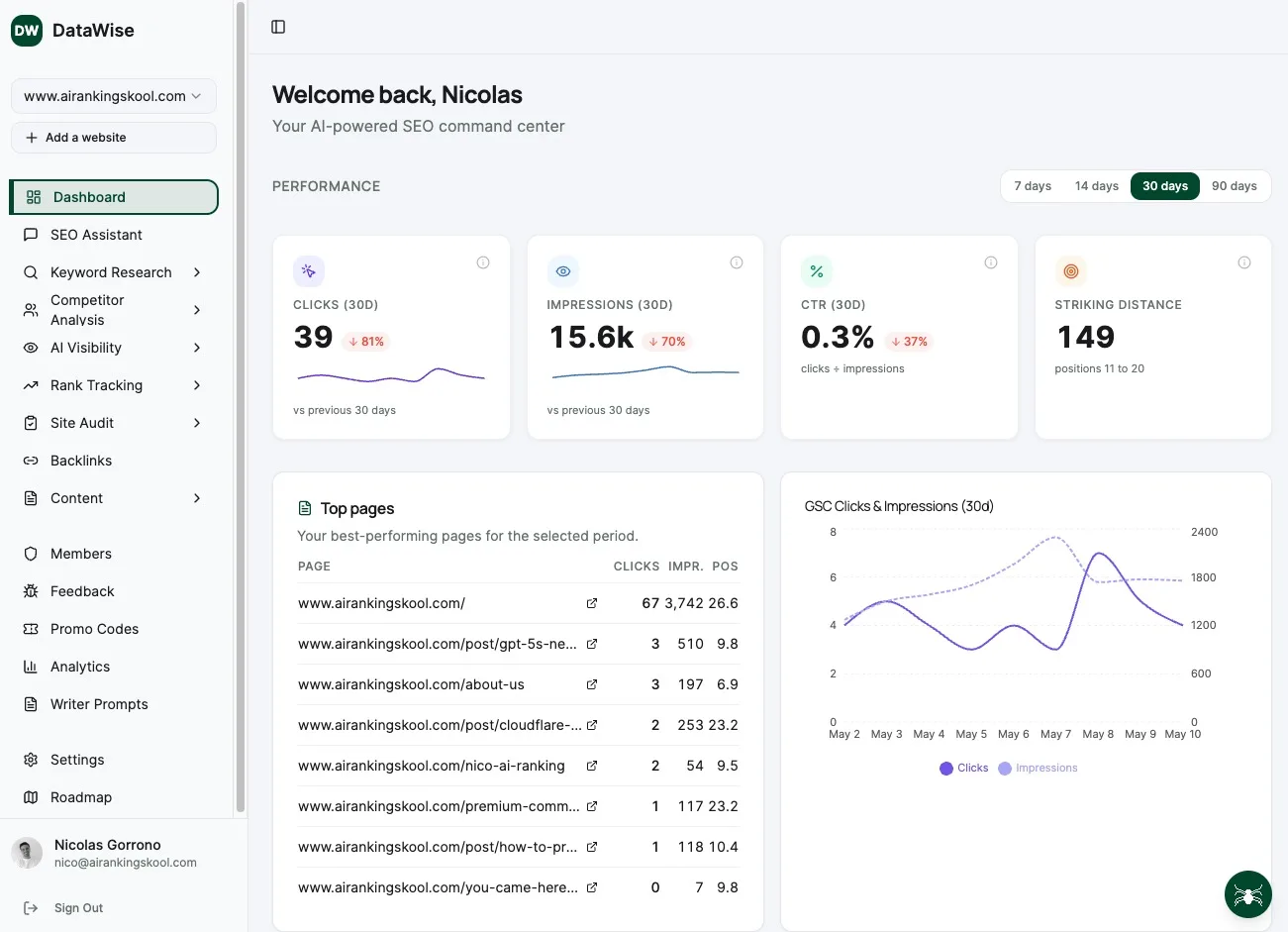
This is the step most guides skip. Defining metrics like "citation score" or "share of voice" is easy; running the loop is what moves the needle. The workflow: (1) ask the engines the real buyer questions and record whether you are cited, (2) note your citation share versus competitors, (3) fix the gaps (missing answer-first passage, weak structure, thin trust), then (4) re-test and watch the share move. Inside our community we run this with DataWise, which audits live AI citations and tracks your share over time so optimization becomes measurable instead of guesswork.
Answer engine optimization examples
The clearest AEO example is a definition page that opens with a tight, quotable answer. A page titled "What is answer engine optimization?" that leads with a one-sentence definition gets lifted into AI answers far more often than one that buries the definition in paragraph four.
- Direct-answer block: a comparison page that opens "AEO optimizes for the answer; SEO optimizes for the ranking" is easy for an engine to quote verbatim.
- FAQ block with schema: a product page that answers "how much does X cost?" in one sentence under an FAQPage-marked heading can feed an AI answer about pricing.
- Comparison table: a clean "Tool A vs Tool B" table is a format engines love to extract into a recommendation.
- Numbered how-to: a HowTo-marked step list often becomes the steps an engine reads back to a user.
Best AEO tools (and where DataWise fits)
The best answer engine optimization tools do three jobs: find the questions to target, check your content is structured and marked up correctly, and verify whether AI engines actually cite you. Most teams cobble this together from a keyword tool, a schema validator (like Google's Rich Results Test) and manual spot-checks in ChatGPT and Perplexity.
DataWise, free for community members, closes the loop that most AEO tools leave open: it audits your live AI citations across engines and tracks your citation share over time, so you can prove what your AEO work is doing. If you would rather have done-for-you AEO services or a structured AEO course, that lives inside the AI Ranking community where we run the playbook together. For the broader automation side, see AI SEO.
Watch: SEO, AEO and GEO explained
Nico breaks down the three layers of AI search, where AEO fits between SEO and GEO, and the exact page structure (separate service pages, capsule-style answer-first content, and footprint diversification) driving results for AI Ranking members:
Learn Generative Engine Optimization hands-on inside the community
Courses, live calls and DataWise to track your AI citations and AI Overview presence.