- ChatGPT for SEO has two meanings: using ChatGPT as an SEO assistant, and optimizing to be cited inside ChatGPT's answers (GEO).
- It is genuinely useful for keyword research, content-gap analysis, on-page elements, briefs and technical snippets, with human review.
- ChatGPT hallucinates facts and citations, so every output needs verification and editing before it ships.
- Getting cited inside ChatGPT is generative engine optimization, a different discipline from prompting ChatGPT.
- ChatGPT search runs on Bing, so Bing Webmaster Tools and its AI Performance tab are your free window into ChatGPT visibility.
ChatGPT for SEO means two things: using ChatGPT as an assistant to do SEO work faster (keyword research, briefs, titles, schema), and optimizing your content so it gets cited inside ChatGPT's answers. This guide covers both, because the same search collides both intents and you need each one.
Part of our AI SEO hub, this guide shows how to use ChatGPT across the SEO workflow, gives a copy-paste prompt library, is honest about the limits (hallucinations, detection, quality), and then routes the "rank inside ChatGPT" half to where it belongs: generative engine optimization.
What is ChatGPT for SEO?
ChatGPT for SEO is using OpenAI's ChatGPT to assist with SEO tasks like keyword research, content briefs, outlines, drafts, title tags, meta descriptions and technical snippets. It acts as a fast, tireless assistant that handles the first 80 percent of many tasks, leaving you to verify, refine and apply judgment.
Is ChatGPT good for SEO?
Yes, ChatGPT is good for SEO for ideation, drafting and on-page tasks, with important caveats. It accelerates keyword clustering, content-gap analysis, briefs and metadata, and it is excellent at restructuring and summarizing. But it can invent facts, statistics and citations, and it does not have live SERP data unless you connect a tool, so a human must verify everything before publishing.
How to use ChatGPT for SEO
Keyword research (seed to long-tail to clustering)
Use ChatGPT to expand seed keywords into long-tail variations and cluster them by intent. It will not give accurate search volume (verify that in Semrush, Ahrefs or Search Console), but it is fast at grouping queries into topics and spotting the questions behind them.
Competitive and content-gap analysis
Paste competitor headings or a URL's outline and ask ChatGPT what subtopics and entities are missing from your draft. It is strong at finding gaps in coverage, which directly helps topical authority.
On-page: titles, meta descriptions, headers
ChatGPT is reliably good at generating title tag and meta description options, H1 to H3 structures, and LSI-aware phrasing. Give it the target keyword and intent, then pick and refine the best output.
Content briefs and drafting
Use ChatGPT to turn research into a structured brief and a first draft, then hand it to a human editor. Never publish unedited AI text: see AI content writing for the editing workflow that protects E-E-A-T and quality.
Technical SEO tasks
ChatGPT can write JSON-LD schema markup, robots.txt rules, regex for redirects, and XML sitemap snippets, and explain canonicalization or noindex decisions. Always test generated code before deploying it.
The SEO prompt library
Here are copy-paste SEO prompts for ChatGPT. Add your own context (brand, audience, target keyword) for better output.
Keyword clustering:
"Group these keywords into topic clusters by search
intent. Label each cluster and flag the best pillar
page target: [paste keywords]"

Content gap:
"Here are the H2s from the top 3 ranking pages for
'[keyword]'. List subtopics and entities my draft is
missing: [paste headings]"

Titles & metas:
"Write 5 title tags (max 60 chars) and 3 meta
descriptions (max 155 chars) for a page targeting
'[keyword]' with intent [informational/commercial]."

Schema:
"Generate valid FAQPage JSON-LD for these 5 Q&A pairs:
[paste Q&As]"
For SEO prompts that target AI citations specifically, the community library goes deeper than any blog post can.
Limits and risks of ChatGPT for SEO
ChatGPT's biggest risks for SEO are hallucinated facts and fake citations, outdated information, and thin, generic content if you publish its output raw. It does not know your real performance data and will confidently invent statistics, so treat every factual claim as unverified until you check it.
Is ChatGPT content good for SEO?
ChatGPT content can be good for SEO when a human edits it for accuracy, adds real expertise and experience, and removes generic filler. Google does not penalize AI content for being AI-generated; it penalizes unhelpful, low-quality content regardless of how it was made. The deciding factor is editing and E-E-A-T, not the tool.
Can Google detect ChatGPT content?
Google has not confirmed reliable AI-text detection, and AI detectors are unreliable, so the practical answer is that detection is the wrong thing to worry about. Focus on whether the content is helpful, accurate and original; that is what Google's systems actually reward.
How to get found and cited inside ChatGPT
Optimizing to be cited inside ChatGPT's answers is a different discipline called generative engine optimization (GEO), sometimes "SEO for ChatGPT." Instead of prompting ChatGPT, you make your site easy for it to find, read and quote. Here are the concrete first steps, with the full framework in our GEO guide.
Get on Bing Webmaster Tools (ChatGPT runs on Bing)
The single most-missed step: ChatGPT's web search is powered by Bing's index, so if Bing cannot find you, ChatGPT search struggles to cite you. Create a free Bing Webmaster Tools account, verify your site, and submit your sitemap. If your Google Search Console is already set up, you can import everything into Bing in a couple of clicks instead of redoing it.
Bing Webmaster Tools also has an AI Performance tab that reports citations from Microsoft Copilot and partners. Because those run on the same Bing index ChatGPT search uses, it is the closest free window you have into your Bing-powered AI visibility: your total AI citations and how many of your pages get cited over time. If you only check one free tool for ChatGPT visibility, check this one.
Add llms.txt and the right schema
Two low-effort signals help any AI engine understand your site: an llms.txt file (a Markdown map of your key pages, a one-click toggle in Yoast on WordPress) and correct schema markup, which Google has said its AI uses to confirm what is on a page. A fast way to find gaps: paste a URL into ChatGPT or Perplexity and ask which schema types it is missing, then validate the result in a schema validator before you add it.
Submit your products to ChatGPT shopping
If you sell products, OpenAI has begun letting businesses submit their products through a form so items can surface, and be bought, directly inside ChatGPT's shopping results. It is early and lightly documented, but submitting costs nothing and can only improve your odds of appearing.
Use ChatGPT to rewrite your content so AI cites it
One of the highest-leverage ways to use ChatGPT for SEO is to restructure your existing content so AI engines can lift it. Most content that gets cited shares one trait: it answers the question immediately, in a self-contained block.
This is the capsule content method. Under each heading written as a question, give a short, direct answer first (roughly 30 to 50 words) with no links inside it, then explain underneath. The test: can someone understand that paragraph without reading anything else on the page? If yes, an AI engine can quote it cleanly. The full method lives in our GEO guide and AEO guide.
The rewrite workflow
- In Google Search Console, sort your pages by average position and find the ones ranking around 8 to 20 (page two): already indexed, just not winning yet.
- Paste one of those URLs into ChatGPT (or Perplexity, which reads live pages well) and ask it to score the page for answer-first "capsule" structure, section by section.
- Have it rewrite your question-headings and opening sentences to answer directly, keeping your tone of voice, then apply the changes.
- Re-check in a few weeks: these page-two pages tend to move fastest.
Audit this page for the capsule content method and rewrite it
to get cited by AI search. For each section: (1) is the heading
a question? (2) does the first sentence answer it directly in
30-50 words with no links? Give a section-by-section score, then
rewrite my H2s as questions and my opening sentences as direct
answers, keeping my tone of voice.
Here is the content: [paste URL or text]Best ChatGPT SEO tools and DataWise
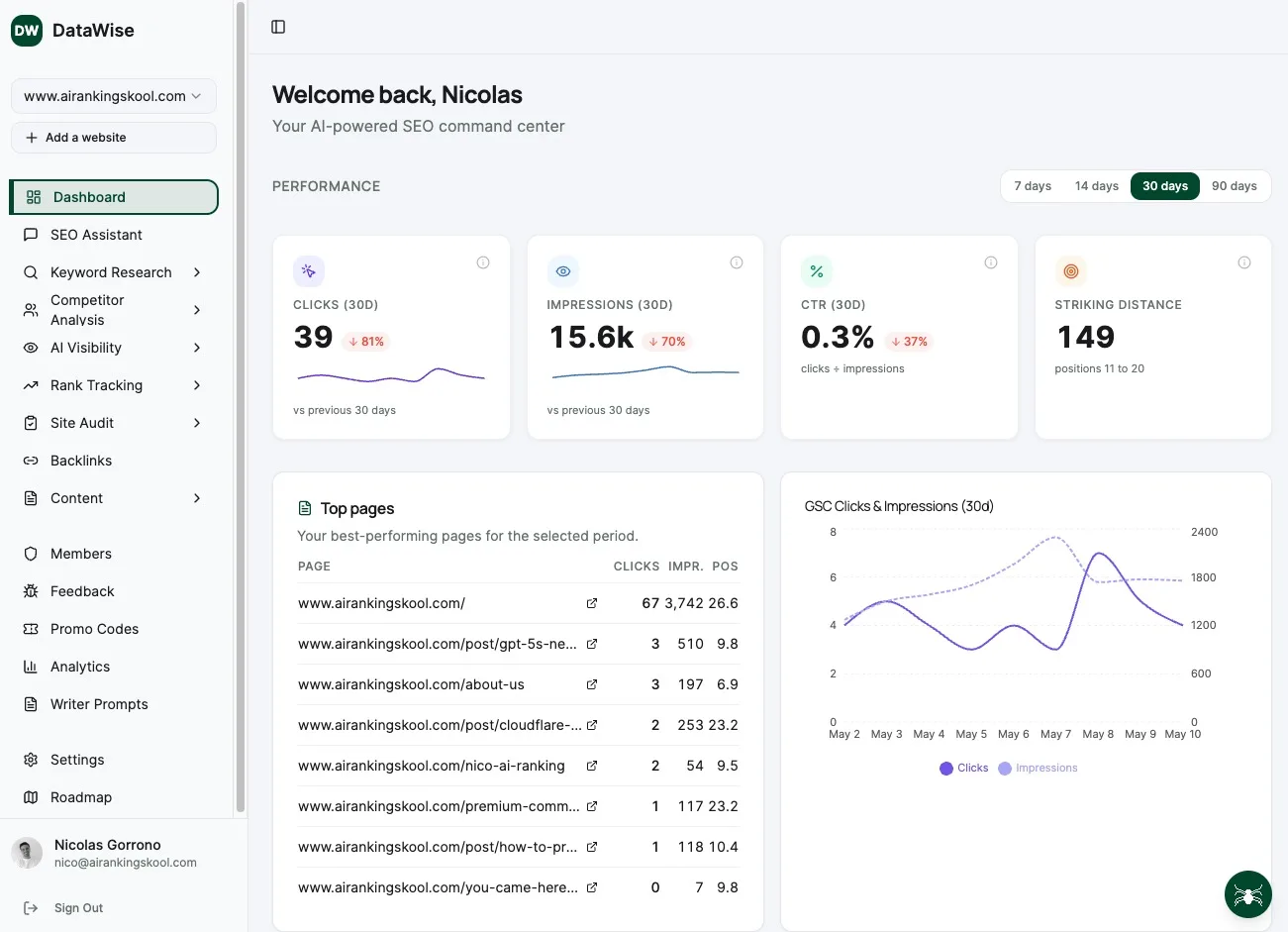
Beyond ChatGPT itself, custom GPTs and SEO plugins extend it for repeatable workflows, and dedicated platforms add live SERP data it lacks. For the full stack see the best AI SEO tools. To check whether your ChatGPT-assisted content actually gets cited by AI engines, our tool DataWise (free for members) tracks your AI visibility and citation readiness.
How we teach AI SEO inside the community
The AI Ranking community gives you the prompt library, the custom GPT setups, and the editing workflows that turn ChatGPT from a novelty into a real SEO engine, plus the GEO playbook for getting cited inside ChatGPT. Members get DataWise free to measure the results.
Learn AI SEO hands-on inside the community
Courses, live calls and DataWise to automated site audits + content optimization in one click.