- SEO audit tools crawl your site, score it, and return a prioritized list of technical, on-page and content issues to fix.
- You can run a real audit for free with Google Search Console, PageSpeed Insights and Screaming Frog (up to 500 URLs).
- Paid suites like Semrush and Ahrefs add automated scoring and scheduled crawls; dedicated crawlers like Screaming Frog and Sitebulb go deepest on technical SEO.
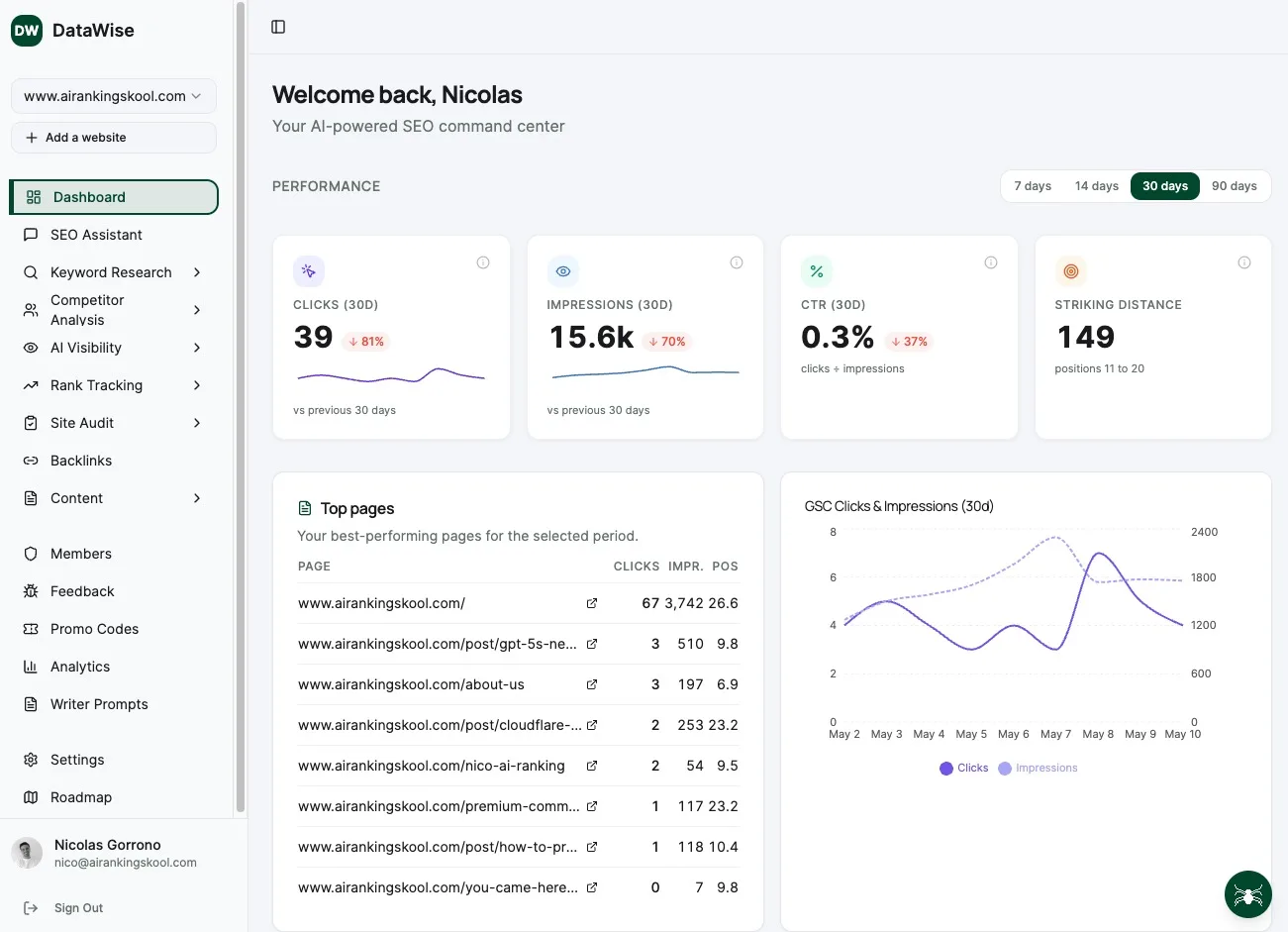
- Most tools still ignore AI-search readiness; DataWise audits classic SEO and AI citation in one pass and is free for members.
SEO audit tools are software that crawls your website, evaluates it against ranking factors, and hands you a prioritized list of issues to fix, covering technical SEO, on-page elements, content and backlinks. The best ones turn a sprawling site into a clear scorecard with the highest-impact problems at the top.
This guide compares the leading website SEO audit tools in 2026, free and paid, so you can pick the right one for your site. It is part of our complete SEO audit guide. If you want the method rather than the software, see how to do an SEO audit and the SEO audit checklist.
What SEO audit tools do
An SEO audit tool simulates how a search engine crawls your site, then flags everything that could hurt rankings: broken links, redirect chains, missing title tags, slow pages, duplicate content, indexation errors and weak internal linking. Instead of checking pages by hand, you get the whole site scored in minutes.
What makes a good SEO audit tool
- Full-site crawl: finds crawlability and indexation issues across every URL, not just the homepage.
- Prioritized issues: ranks problems by severity so you fix what matters first, not alphabetically.
- Core Web Vitals: reports LCP, INP and CLS, ideally with field data.
- On-page checks: title tags, meta descriptions, headings, alt text and internal links.
- Clear reporting: a dashboard, PDF report or CSV export you can act on or share.
- Re-crawl tracking: scheduled audits so you can see issues trend down over time.
What a tool outputs
Most tools produce an overall SEO score, a categorized issue list (errors, warnings, notices), and a report you can export as a PDF, dashboard or spreadsheet. Agencies often want a white-label SEO audit report; SEOptimer and SE Ranking handle that well. The output is only useful if it tells you what to fix first, which is why prioritization matters more than the raw issue count.
Best SEO audit tools compared
Here are the best SEO audit tools at a glance, grouped by what they do best.
| Tool | Best for | Free tier | Paid from | Type |
|---|---|---|---|---|
| Semrush Site Audit | All-in-one audits + reporting | Limited free account | $139.95/mo | Cloud suite |
| Ahrefs Site Audit | Technical + backlink depth | Webmaster Tools (free) | $29/mo | Cloud suite |
| Screaming Frog | Deep technical crawls | Up to 500 URLs | $279/yr | Desktop crawler |
| Sitebulb | Visual technical audits | Free trial | $18/mo | Desktop crawler |
| SE Ranking | Budget all-in-one | Free trial | $52/mo | Cloud suite |
| SEOptimer | Quick white-label reports | 5 free audits/mo | $29/mo | Browser tool |
| BrightLocal | Local SEO audits | Free trial | $39/mo | Local platform |
| DataForSEO | Pay-as-you-go audit data | $1 signup credit | Fractions of a cent per request | Data API |
| Google Search Console | Indexing + real search data | Fully free | Free | Google tool |
Prices are entry-level plans as of 2026 and change often, so use the linked pricing pages for current numbers. Most paid tools also discount annual billing.
All-in-one suites: Semrush, Ahrefs, SE Ranking
If you want one tool that audits, tracks rankings and analyzes backlinks, a suite is the answer. Semrush Site Audit and Ahrefs Site Audit are the market leaders, with automated scoring, scheduled crawls and prioritized issue lists. SE Ranking covers the same ground at a lower price, which suits smaller businesses.
Technical crawlers: Screaming Frog, Sitebulb
For the deepest technical SEO audit tools, use a dedicated crawler. Screaming Frog is the industry standard for finding redirect chains, status code errors, orphan pages and broken links; it is free up to 500 URLs. Sitebulb adds visual crawl maps and plain-English explanations. Both feed directly into a technical SEO audit.
On-page, local and white-label tools
For on-page SEO audit tools, Semrush and SEOptimer both grade individual pages on titles, meta and content. For local SEO audit tools, BrightLocal checks Google Business Profile, citations and local rankings. Agencies that need white-label SEO audit tools (rebranded PDF reports) get the best value from SEOptimer and SE Ranking, both low-cost and easy to skin.
Best free SEO audit tools
Yes, there are genuinely useful free SEO audit tools, and you can run a complete audit without paying for anything. The best free SEO audit tools combine Google's own stack with a free crawler.
| Free tool | What it audits |
|---|---|
| Google Search Console | Indexing, coverage errors, real queries, Core Web Vitals |
| PageSpeed Insights | Core Web Vitals (LCP, INP, CLS) and performance |
| Screaming Frog (free) | Technical crawl up to 500 URLs |
| Google Analytics 4 | Traffic, engagement and conversion data |
| SEOptimer / Woorank (free scan) | Quick on-page score and report |
| Chrome Canary + Lighthouse | Agentic browsing: how well an AI agent can access and use your site |
Google's free stack
Start with Google Search Console for indexation and the queries you already rank for, then PageSpeed Insights for Core Web Vitals. These are the most accurate free data you can get because they come straight from Google. Pair them with the free tier of Screaming Frog to crawl your site, and you have covered most of an audit at zero cost.
For technical users: DataForSEO (pay as you go)
If you are comfortable with a little technical setup, DataForSEO is a powerful pay-as-you-go option. Instead of a monthly subscription, you top up credit (from a $50 minimum) and pay only for what you run, often a fraction of a cent per request.
It is a data API rather than a point-and-click dashboard, so you pull crawl, on-page, SERP and backlink data through the API or a no-code connector (Google Sheets, Make, n8n). That makes it ideal for one-off audits and small projects where a recurring subscription would be overkill: you can run a lot of auditing for a few dollars and stop paying the moment you are done. It is more technical than a tool like Semrush, so it suits developers and hands-on marketers.
This is the kind of data DataWise is built on, so community members get the depth without wiring up the API themselves.
How to choose the right SEO audit tool
Choosing comes down to one question: do you need a quick health check or an ongoing system? A free checker gives you a one-time score; a paid tool gives you scheduled crawls, history and prioritization.
Use a free checker (SEOptimer, Woorank) for a fast snapshot or a one-off client pitch. Use a paid tool (Semrush, Ahrefs, SE Ranking) when you audit regularly, manage multiple sites, or need to track issues trending down over time. Use a dedicated crawler (Screaming Frog, Sitebulb) when technical depth is the priority.
Whatever you pick, the tool only surfaces issues; you still need the method to interpret and prioritize them. That is what the step-by-step audit guide covers, and where the community helps you turn a raw issue list into a real fix plan.
Do SEO audit tools check AI-search readiness?
Most SEO audit tools do not check AI-search readiness yet. They audit for classic Google rankings, but they rarely tell you whether ChatGPT, Perplexity, Gemini or Google AI Overviews can crawl, read and cite your content. That gap matters because answer engines now drive a growing share of discovery.
An AI-search (AEO) audit adds checks that classic tools miss: are AI crawlers like GPTBot, ClaudeBot and PerplexityBot allowed in robots.txt; does each page answer its core question in the first sentence or two; is your content structured in clean lists and tables a model can lift; and do schema and author signals build the trust models look for. Semrush and SEO Site Checkup have started nodding at this, but none teach you how to audit for it.
One AI-readiness check you can already run for free is agentic browsing: how well an AI agent can load and use your pages. Install Chrome Canary, open DevTools, go to the Lighthouse tab, tick Agentic Browsing and analyse the page. We walk through it in the SEO audit guide.
This is the generative engine optimization layer, and it is what we specialize in. Learn the full discipline in our AI SEO guide.
DataWise: classic and AI-search audits in one
Inside the AI Ranking community we use DataWise, our SEO audit tool that crawls your site, scores it, and returns a prioritized fix list covering both classic SEO and AI-search readiness in a single pass. It checks crawlability, on-page elements and Core Web Vitals like any audit tool, then adds the AEO layer most tools skip: AI-crawler access, answer-first structure, and schema for citation.
DataWise is free for members. If you want the tool plus the method and a community running audits alongside you, that is exactly what we built.
Run better audits with the community
Get DataWise free, audit your site with people doing the same work, and turn issue lists into shipped fixes. Join the AI Ranking community to get started.
Learn SEO Audits hands-on inside the community
Courses, live calls and DataWise to run a full automated audit and get a prioritized fix list.